
They Built
the Church.
When white congregations told them to worship apart, African Americans built their own institutions — and those institutions became the foundation of every freedom movement that followed. The Black church is where America’s conscience was kept alive.
–1800
& First Church
They were forbidden to worship. So they worshipped in secret — and built the oldest surviving institution in Black American life.
In the plantation South, enslaved people were forbidden from gathering without white supervision. They gathered anyway — in the woods, in swamps, in hidden clearings called hush arbors or “brush arbors.” They sang in codes. They prayed in whispers. They preserved spiritual traditions brought from West Africa and fused them with the Christianity their enslavers used to justify their bondage — and transformed it into a theology of liberation.
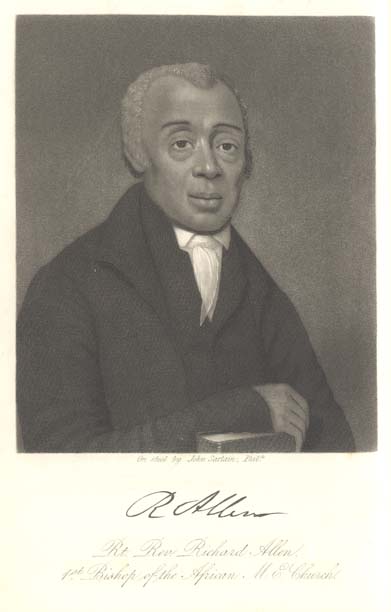
In 1787, Richard Allen and Absalom Jones founded the Free African Society in Philadelphia — the first Black mutual aid organization in America, which became the foundation of the African Methodist Episcopal (AME) Church, established formally in 1816. The Black church was not derived from the white church — it was built in opposition to it, after Allen and Jones were pulled from their knees during prayer at St. George’s Methodist Church and told to move to the segregated gallery.
“We will stretch out our hands and cry to the God of Ethiopia — for the day of our redemption has come.”
Richard Allen, founder — African Methodist Episcopal Church, 1816Hush Arbors — Worship Under Prohibition
Enslaved people held secret religious gatherings in hidden outdoor spaces — “hush arbors” — away from white surveillance. They used quilts to muffle sound, sang in coded spiritual language, and maintained African spiritual traditions alongside Christian practice. The hush arbor is the origin of the Black church — born in defiance of laws that made unauthorized Black assembly a criminal act.
Sacred ResistanceRichard Allen & the AME Church
Allen and Absalom Jones were pulled from their knees during prayer at St. George’s Methodist Church and directed to the segregated gallery. They walked out and founded the Free African Society in 1787. Allen established Bethel African Methodist Episcopal Church in 1793 and the formal AME denomination in 1816 — the first independent Black denomination in America. It became a primary institution of Black resistance, education, and community organization.
First Independent Black DenominationNat Turner — The Preacher Who Led the Rebellion
Nat Turner was a literate, deeply religious enslaved man who believed he received divine visions commanding him to lead an uprising. The Southampton Rebellion of 1831 killed approximately 60 white people and was suppressed with massive retaliatory violence against Black Virginians. Turner was captured, tried, and executed. Southern states passed laws restricting Black literacy and worship in direct response. His faith was the source of his conviction.
Faith as Resistance–1945
to Migration
The church built the schools, the banks, the insurance companies, and the newspapers — because no other institution would.
After emancipation, the Black church became the center of community infrastructure. Where the Freedmen’s Bureau could not reach and white institutions would not serve, Black congregations built schools, funded colleges, established mutual aid societies, and created the organizational networks that sustained Black community life through Reconstruction and into Jim Crow. Historically Black Colleges and Universities were overwhelmingly founded by Black churches and Black denominations.
The Great Migration brought Black churches North — and transformed Northern cities. Daddy Grace and Father Divine built massive urban ministries that fed the hungry during the Depression. Adam Clayton Powell Sr. built Abyssinian Baptist Church in Harlem into one of the largest Protestant congregations in America — and his son, Adam Clayton Powell Jr., used the pulpit as a launching pad for Congress. The church was never only about heaven. It was always also about here.
“The Black church has been and continues to be the most important institution in the African American community — not despite politics, but through it.”
Two Americas — ERA V DocumentationThe Church Built the HBCUs
The majority of Historically Black Colleges and Universities were founded by Black churches, Black denominations, or with direct church support. Fisk University (AME), Morehouse College (Baptist), Spelman College (Baptist), Howard University (Congregationalist), and dozens more trace their origins to Black religious institutions that understood education as a sacred obligation. The academy and the church were not separate institutions — they were expressions of the same conviction.
HBCUs Founded by Black ChurchesAbyssinian Baptist — Politics from the Pulpit
Under Adam Clayton Powell Sr., Abyssinian Baptist Church in Harlem became one of the largest Protestant congregations in America. His son, Adam Clayton Powell Jr., used the church as a political base, became the first Black member of the New York City Council in 1941, and was elected to Congress in 1944. He served 11 terms and used his congressional power to attach anti-discrimination riders to federal legislation. The church made the congressman.
Church to CongressFather Divine & Depression-Era Ministry
Father Divine’s International Peace Mission Movement operated communal households and restaurants across the country during the Great Depression — feeding thousands of people regardless of race at a time when government relief was inadequate and racially administered. His movement attracted followers across racial lines and operated on a cash-only, debt-free basis. He registered voters, fought lynching, and challenged segregation decades before the civil rights movement’s major campaigns.
Depression-Era Relief Network–1968
Movement
The civil rights movement was a church movement. The meetings were in sanctuaries. The songs were hymns. The leaders were ministers.
The Montgomery Bus Boycott began at Dexter Avenue Baptist Church, where a 26-year-old minister named Martin Luther King Jr. had just arrived as pastor. The Southern Christian Leadership Conference — the organizational backbone of the movement — was explicitly rooted in Black church networks. Ralph Abernathy, Fred Shuttlesworth, Wyatt Tee Walker, C.T. Vivian, Joseph Lowery — the leadership of the movement were ministers who understood protest as prophetic action.
On September 15, 1963, a bomb planted by members of the Ku Klux Klan destroyed the 16th Street Baptist Church in Birmingham, Alabama, killing four girls — Addie Mae Collins, Cynthia Wesley, Carole Robertson, and Carol Denise McNair — during Sunday school. The bombing was intended to break the movement. It hardened it. The church had been a primary organizing site for the Birmingham Campaign. The target was not incidental.
“If you will protest courageously, and yet with dignity and Christian love, when the history books are written in future generations, the historians will have to pause and say, ‘There lived a great people — a Black people — who injected new meaning and dignity into the veins of civilization.'”
Dr. Martin Luther King Jr., Montgomery, Alabama, 1955The Montgomery Bus Boycott — 381 Days
The Montgomery Bus Boycott began after Rosa Parks’s arrest on December 1, 1955. The organizing infrastructure was the Black church network — Dexter Avenue Baptist, First Baptist, and dozens of other congregations coordinated 40,000 Black residents who refused to ride city buses for 381 days. The carpool system was organized through church networks. The Supreme Court ruled bus segregation unconstitutional in November 1956. The church won.
381 Days · Church-Organized16th Street Baptist Church Bombing
Four members of the Ku Klux Klan bombed 16th Street Baptist Church during Sunday school, killing Addie Mae Collins (14), Cynthia Wesley (14), Carole Robertson (14), and Carol Denise McNair (11). The church had been a primary organizing site for the Birmingham Campaign. No one was convicted until 1977. The last conviction came in 2002 — 39 years after the bombing. The church was rebuilt and still stands.
First Conviction — 14 Years LaterDr. Martin Luther King Jr. — Murdered in Memphis
King was assassinated at the Lorraine Motel in Memphis on April 4, 1968, while supporting a sanitation workers’ strike. He was 39 years old. He had received the Nobel Peace Prize in 1964. He had been under FBI surveillance for years, with Director J. Edgar Hoover calling him the most dangerous man in America. His final campaign — the Poor People’s Campaign — targeted economic justice as directly as racial justice. He was killed in his 13th year of public ministry.
39 Years Old · FBI SurveilledVoices from the Tradition
The theological and prophetic tradition of the Black church — selected passages from the record
Burned or
Attacked
The Church as Target
Because the Black church was the center of Black community life — the meeting hall, the school, the bank, the organizing space — it was also the primary target of white supremacist violence. Church bombings, burnings, and attacks are documented across every era of American history, from the antebellum period through the present day.
The 1996 church burning wave alone saw over 100 Black churches destroyed across the South. The Emanuel AME Church shooting in Charleston in 2015 — nine people killed during Bible study — was the latest in a 200-year pattern of attacking the institution that would not break. The shooter specifically chose Emanuel AME because of its history as a center of Black resistance.
The Faith Record in Our Backyard
Evans Metropolitan AME Zion — Fayetteville’s Anchor
Evans Metropolitan AME Zion Church in Fayetteville is one of the oldest Black congregations in North Carolina, with roots in the antebellum era. Its history mirrors the national AME tradition — established as an independent expression of Black faith and community, serving as a center of education, mutual aid, and civic engagement throughout the Jim Crow era and beyond. It is a direct local expression of the institutional tradition documented on this page.
Fayetteville State — Founded by the Church
Fayetteville State University was founded in 1867 by seven Black men — most of them church members — who pooled their resources to establish a school for Black children in the aftermath of emancipation. The pattern — church community founding an educational institution — is the direct NC expression of the national HBCU-church connection. FSU is the institutional descendant of that act of faith.
The Black Church in Cumberland County Today
Cumberland County’s Black churches remain centers of community organization, voter registration, social services, and cultural preservation. The Market House designation debate — whether to officially recognize Fayetteville’s former slave market as a site of atrocity — has been an active area of Black church advocacy. The prophetic tradition is not historical in Fayetteville. It is present tense.
The record is incomplete.
We are completing it.
This page documents confirmed religious milestones and the faith tradition as an instrument of resistance and survival. Additional entries are in research — from the hush arbor era to present-day prophetic ministry. Every entry includes Chicago-style citations, primary sources, and NC local connections where documentable.