
I. Sundiata Keita and the Foundation of Mali
The Mali Empire did not begin with Mansa Musa. It began with Sundiata Keita, whose story is preserved in one of the great oral epic traditions of the world — the Sundiata Epic, performed by griots (hereditary oral historians and musicians) across West Africa from the thirteenth century to the present. The griot tradition is itself a civilizational achievement: a professional class of oral historians who preserved, transmitted, and performed the records of the state with a precision and a narrative craft that the European scholarly tradition spent centuries refusing to treat as legitimate historical evidence. It is legitimate historical evidence. It is primary source material of the highest order.
Sundiata Keita was the founder of the Mali Empire. He united the Mandinka peoples of the upper Niger River basin after defeating the Sosso king Soumaoro Kanté at the Battle of Kirina in approximately 1235 CE. Following his victory, Sundiata convened the Gbara — the great assembly — at Kurukan Fuga, where the Kouroukan Fouga was proclaimed. This constitutional charter established a governance framework with documented provisions that anticipate the principles of modern democratic governance by several centuries. The charter prohibited the enslavement of free persons. It established protections for women and the rights of foreigners. It created a division of political authority between the emperor and the assembly. It codified environmental protections — prohibiting the felling of certain trees and the destruction of certain lands. UNESCO inscribed the Kouroukan Fouga on its Intangible Cultural Heritage list in 2009, recognizing it as one of humanity’s foundational governance documents.
England’s Magna Carta, signed in 1215 — twenty years before Kurukan Fuga — was a baronial document extracted from a reluctant king under military duress. It established protections for the nobility and the Church. It was routinely violated throughout the thirteenth century. It did not prohibit slavery. The Kouroukan Fouga prohibited it.
II. The Architecture of the Empire
The Mali Empire at its peak — roughly from 1235 to 1400 CE — encompassed an area approximately the size of Western Europe. It controlled the trans-Saharan trade routes that connected the gold and salt of West Africa to the Mediterranean world, the Middle East, and beyond. The two great commodities that funded Mali’s wealth were gold — from the Bambuk and Bure goldfields of the upper Senegal and Niger rivers — and salt — from the mines of Taghaza in the Sahara, where salt was so scarce that it traded by weight at the same value as gold in the markets of the Niger bend.
The Wolof and Mande peoples whose agricultural knowledge — particularly rice cultivation and indigo production — was embedded in the Mali Empire’s economy were later specifically targeted by the Atlantic slave trade. Their knowledge traveled with them to South Carolina and North Carolina’s coastal lowlands, where planters paid premium prices for enslaved Africans from the “Rice Coast” because they understood the agricultural technology those people carried. The wealth of the American plantation economy was, in part, built on the appropriated knowledge of the civilization documented in this entry.
III. Mansa Musa I — The Hajj of 1324
Mansa Musa I ascended the throne of Mali in approximately 1312 CE. By the 1320s he governed an empire of an estimated 400,000 square miles, controlling more than half the world’s supply of gold and salt. In 1324 CE he undertook the hajj — the pilgrimage to Mecca required of all Muslims of means — and the passage of his caravan through the Islamic world constitutes one of the most thoroughly documented events of the medieval period, recorded in Arabic by historians who witnessed it or interviewed those who had.
The caravan is described by contemporaneous and near-contemporaneous sources as comprising approximately 60,000 persons and 80 camels each carrying between 50 and 300 pounds of gold. The numbers vary by source — as numbers reported by eyewitnesses to extraordinary events always do — but the economic effect is not disputed. The Syrian historian al-Umari, who arrived in Cairo approximately twelve years after Mansa Musa’s passage and interviewed Egyptian officials who had been present, recorded that the value of gold in Cairo had not recovered. The mithqal of gold, which had traded above 25 silver dirhams before Musa’s arrival, was still trading well below that value a decade after his departure. A single man’s charitable giving had measurably altered the currency markets of the largest city in the medieval world.
In Cairo, Musa’s relationship with the Mamluk sultan Al-Nasir Muhammad was tense — partly because Musa refused to prostrate himself before any authority other than God, a refusal Al-Nasir found insulting and Musa held to on principle, and partly because the sheer scale of Musa’s wealth made his visit politically destabilizing. In Mecca, Musa met the Andalusian poet and architect Abu Ishaq al-Sahili, whom he recruited — and handsomely compensated — to return to Mali and design mosques and royal buildings. The Djinguereber Mosque in Timbuktu, which still stands today and is a UNESCO World Heritage Site, was designed by al-Sahili.
IV. The Catalan Atlas and the European Record
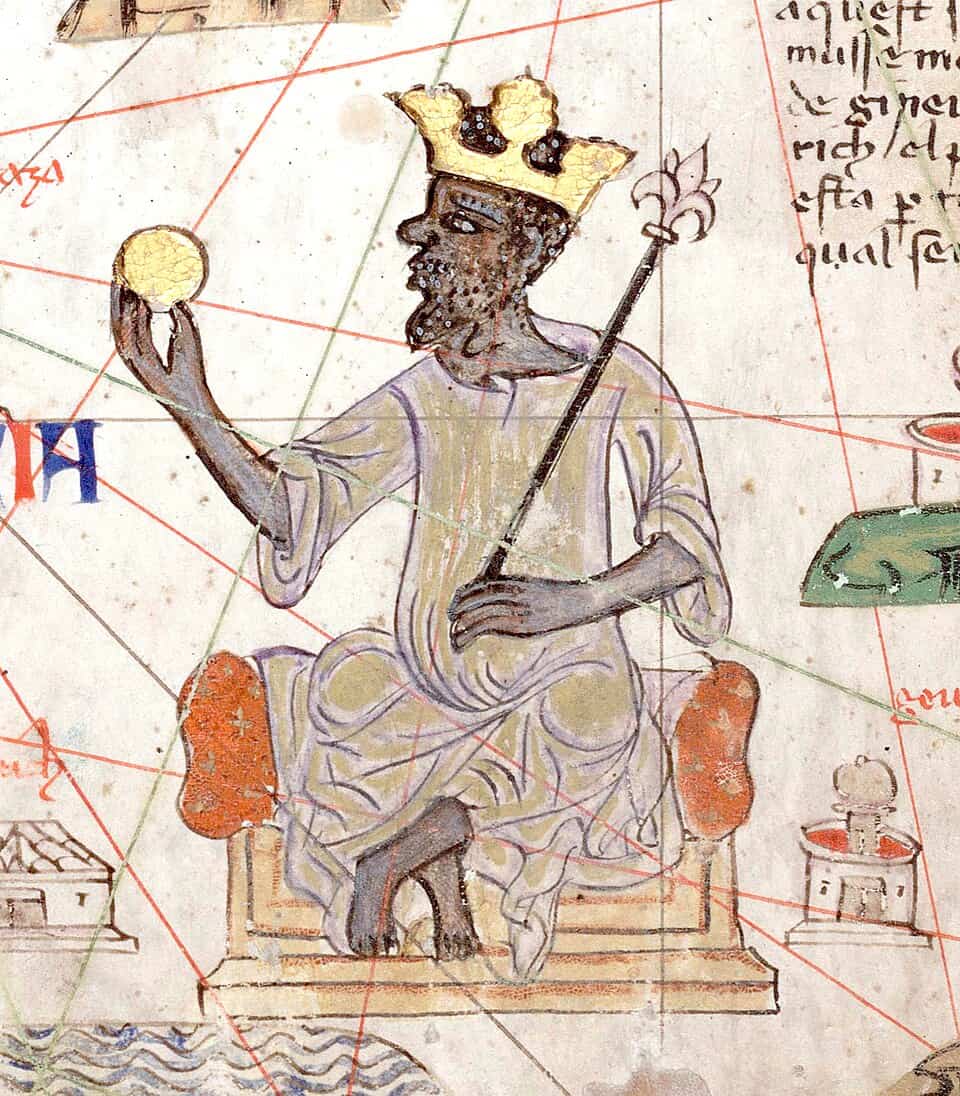
In 1375 CE, the cartographer Abraham Cresques completed the Catalan Atlas for the king of Aragon — the most sophisticated work of European medieval cartography. On the panel depicting West Africa, Mansa Musa sits on a throne, crowned and sceptered, holding a gold nugget the size of his fist, rendered in gold leaf on vellum. The Latin caption beside him reads: This king is the richest and most noble lord in all this region on account of the abundance of gold which is gathered in his land. Cresques drew him as the largest and most prominent figure on the West African panel — more prominent than any European ruler depicted in the atlas.
The Catalan Atlas is held today in the Bibliothèque nationale de France. Its digitized images are publicly available at gallica.bnf.fr. Any person with an internet connection can look at a European king’s cartographer depicting an African emperor as the wealthiest man in the world — fifty years after Musa’s death, when the memory of his wealth was still so vivid that European mapmakers built it into their geography.
This is the record that the Hamitic Hypothesis and five centuries of colonial scholarship required to be buried. It was not buried deeply enough.
V. The Decline and What It Cannot Erase
The Mali Empire declined across the fifteenth century under the pressure of Songhai expansion from the east and Tuareg raids from the north. By the early sixteenth century, the Songhai Empire had absorbed Mali’s core territories. The last documented Mali ruler appears in sources around 1610. The empire lasted approximately 375 years.
The decline of an empire does not retroactively diminish what it built. Rome declined. Greece declined. The Ottoman Empire declined. The decline of Mali does not make Mansa Musa less wealthy, the Kouroukan Fouga less sophisticated, the Djinguereber Mosque less standing, or the Catalan Atlas less gold. The record is the record. The wealth was real. The civilization was real. The constitutional governance was real. What came after 1452 — the Atlantic slave trade, the colonial plunder, the Hamitic Hypothesis — was the project of taking all of it and then denying it ever existed.
Long-Term Consequences
The agricultural knowledge of the Mali Empire’s Wolof and Mande peoples — rice, indigo, sorghum cultivation — was transferred to the American plantation economy through the bodies of enslaved Africans specifically selected for that knowledge. The gold trade routes that funded Mali connected, through the trans-Saharan network, to the Portuguese coastal exploration that would become the Atlantic slave trade. The constitutional tradition of the Kouroukan Fouga — prohibiting the enslavement of free persons — was the legal framework that the Atlantic slave trade violated from its first day of operation. The civilization that Mansa Musa embodied was not a civilization that fell into the slave trade from weakness. It was a civilization that was deliberately targeted, destabilized, and extracted because its wealth was real and Europe needed it.
Learn More…Mansa Musa & the Mali Empire