
They Used
the Law.
The Constitution was used against them for two centuries. African American lawyers turned it into a weapon for justice — in courtrooms, before hostile judges, against the full power of the state. They won more than they lost.
–1883
to Reconstruction
They argued for their freedom in courts that classified them as property. Some of them won.
Before emancipation, enslaved people filed hundreds of freedom suits in American courts — arguing on the basis of ancestry, prior residence in free states, or broken contracts. Elizabeth Freeman (“Mum Bett”) sued for her freedom in Massachusetts in 1781 under the new state constitution’s declaration that “all men are born free and equal.” She won. Her case contributed directly to the judicial abolition of slavery in Massachusetts.
Dred Scott v. Sandford (1857) stands as the Supreme Court’s most infamous ruling — Chief Justice Roger Taney held that Black people, whether enslaved or free, were not citizens and had no standing to sue in federal court. The decision accelerated the nation toward Civil War. The legal system’s capacity for both oppression and — eventually — correction is the central story of the Black legal tradition.
“I heard that paper read yesterday, that says all men are born guiltless and free. I am not a dumb critter. Won’t the law give me my freedom?”
Elizabeth Freeman (“Mum Bett”), 1781Elizabeth Freeman — Freedom Suit Under the Constitution
Freeman, known as “Mum Bett,” heard the Massachusetts Constitution read aloud and petitioned a lawyer named Theodore Sedgwick to argue her freedom. The court ruled in her favor in Brom and Bett v. Ashley — one of the first freedom suits won under the new state constitution. Her victory established a precedent that effectively ended slavery in Massachusetts. She was never enslaved again.
Won · Freedom EstablishedDred Scott v. Sandford — The Court’s Lowest Point
Scott sued for freedom after living in free territories with his enslaver. Chief Justice Taney ruled that Black people — free or enslaved — were not citizens and had no right to sue in federal court. The ruling declared the Missouri Compromise unconstitutional and denied Congress the power to restrict slavery in territories. It was overturned by the 13th and 14th Amendments — but not before it helped ignite the Civil War.
Overturned by Civil War AmendmentsReconstruction Amendments — The Legal Foundation
The 13th (1865), 14th (1866), and 15th (1870) Amendments to the Constitution abolished slavery, granted citizenship and equal protection, and guaranteed the right to vote regardless of race. They were the legal foundation of every civil rights victory that followed. They were also systematically undermined for the next 90 years by state laws, Supreme Court rulings, and organized violence — until the Civil Rights Act of 1964 and Voting Rights Act of 1965 gave them teeth.
Constitutional Foundation of Civil Rights–1967
Legal Campaign
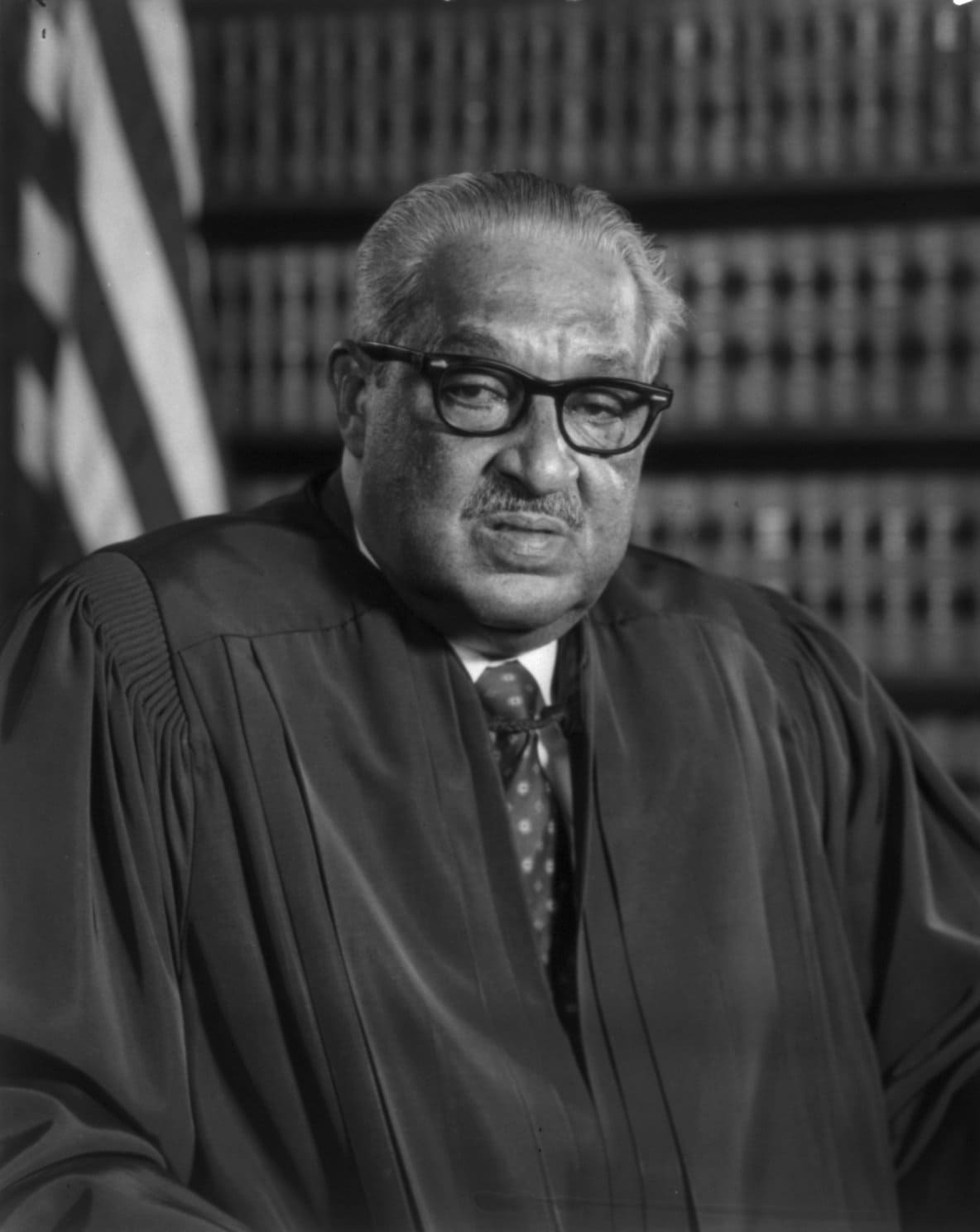
Thurgood Marshall argued 32 cases before the Supreme Court. He won 29. The one that mattered most ended legal segregation in America.
Thurgood Marshall was denied admission to the University of Maryland School of Law because of his race. He attended Howard University School of Law instead, graduated first in his class, and spent the next two decades as the NAACP’s chief litigator — arguing case after case before the Supreme Court. His strategy was systematic: dismantle segregation case by case, precedent by precedent, until the legal foundation of Jim Crow had nowhere left to stand.
On May 17, 1954, the Supreme Court issued its unanimous ruling in Brown v. Board of Education: segregated public schools were unconstitutional. It was the most consequential Supreme Court ruling of the 20th century. Marshall argued the case. President Lyndon Johnson appointed him to the Supreme Court in 1967 — the first Black Justice in American history. He served until 1991.
“In recognizing the humanity of our fellow human beings, we pay ourselves the highest tribute.”
Thurgood Marshall, Supreme Court Justice, 1967–1991The NAACP Legal Campaign — Key Cases
Selected rulings from the NAACP Legal Defense Fund’s systematic dismantling of legal segregation · 1938–1967
–Now
From the first Black Justice to the first Black woman on the Court — each appointment is a marker of how long the institution resisted.
Thurgood Marshall served as Associate Justice from 1967 to 1991 — 24 years on the Court he had spent his career arguing before. He was succeeded by Clarence Thomas, the second Black Justice. The Court would have no Black Justice from Thomas’s retirement until his confirmation. Ketanji Brown Jackson was confirmed as the first Black woman on the Supreme Court in 2022 — 233 years after the Court’s founding.
Bryan Stevenson founded the Equal Justice Initiative in Montgomery, Alabama in 1989, providing legal representation to people on death row and challenging mass incarceration. He has won reversals, relief, or release for over 140 wrongly condemned prisoners. His organization built the National Memorial for Peace and Justice — the first memorial in American history dedicated to victims of lynching. The legal tradition continues.
“Each of us is more than the worst thing we’ve ever done.”
Bryan Stevenson, Equal Justice InitiativeThurgood Marshall — First Black Supreme Court Justice
Marshall was denied admission to the University of Maryland Law School because of his race, attended Howard, and became the NAACP’s chief litigator. He argued 32 cases before the Supreme Court and won 29 — including Brown v. Board. Appointed by LBJ in 1967, he served 24 years. The law school that rejected him was renamed in his honor in 1980.
First Black Supreme Court JusticeBryan Stevenson — Equal Justice Initiative
Stevenson founded EJI to represent people on death row and challenge mass incarceration. He has won relief for over 140 wrongly condemned prisoners and argued successfully before the Supreme Court that mandatory life-without-parole sentences for children are unconstitutional. EJI built the National Memorial for Peace and Justice — America’s first lynching memorial — in Montgomery in 2018.
140+ Wrongful Convictions ReversedKetanji Brown Jackson — First Black Woman on SCOTUS
Jackson was confirmed as Associate Justice of the Supreme Court in April 2022 — the first Black woman in the Court’s 233-year history. A former public defender, she served on the U.S. Sentencing Commission and the D.C. Circuit Court of Appeals before her nomination. Her confirmation came 55 years after Thurgood Marshall became the first Black Justice. The Court was founded in 1789.
First Black Woman · SCOTUS · 233 Years14th Amendment
& Civil Rights Act
The Law Against the Law
The 14th Amendment guaranteed equal protection under the law in 1868. The Civil Rights Act of 1964 finally began to enforce it — 96 years later. In the intervening century, the Supreme Court itself participated in the dismantling of Reconstruction: the Civil Rights Cases (1883) struck down the Civil Rights Act of 1875; Plessy v. Ferguson (1896) established “separate but equal” as constitutional doctrine.
Black lawyers were barred from most state bars. Black defendants were denied counsel. Black witnesses were disbelieved by white juries. Black plaintiffs were denied standing. The legal contributions documented on this page were achieved by people who used the law’s own tools — its language of equality, its procedural demands, its insistence on argument — to force a reckoning the system was designed to prevent.
The Legal Record in Our Backyard
The Wilmington Coup — Law Weaponized
The 1898 Wilmington massacre and coup d’état was not only political violence — it was the use of legal and extralegal mechanisms to strip Black North Carolinians of voting rights, property, and political standing. The new government immediately passed laws targeting Black political participation. No prosecution followed. The legal system’s failure to respond is part of the legal record.
NC NAACP — Legal Advocacy Tradition
The North Carolina NAACP has been a consistent legal advocacy presence — challenging school segregation, voter suppression, and discriminatory policing. The state conference was active in the implementation of Brown v. Board in NC schools. Current NC NAACP litigation includes redistricting challenges affecting Cumberland County representation — a Living Record entry.
Redistricting & Voting Rights — Living Record
Ongoing litigation over North Carolina’s congressional and legislative district maps — and their impact on Black representation in Cumberland County — is an active legal story. The cases invoke the Voting Rights Act and 14th Amendment equal protection doctrine established by the cases documented on this page. The legal tradition is not historical — it is present tense.
Fayetteville State University — Legal Pipeline
FSU has produced graduates who have entered law, public service, and advocacy for over 150 years. Its pre-law and criminal justice programs represent a direct continuation of the legal tradition documented on this page — training students from Cumberland County to enter the courtrooms and legislative halls where this history continues to be made.
The record is incomplete.
We are completing it.
This page documents confirmed legal milestones and cases. Additional entries are in research — from colonial-era freedom suits to present-day civil rights litigation. Every entry includes Chicago-style citations, primary sources, and NC local connections where documentable.