
They Performed
Under Pressure.
Segregated leagues, banned from competition, denied recognition — African American athletes excelled in the face of systems designed to exclude them. Their victories were political whether they chose them to be or not.
–1936
Before the leagues closed them out, they were already winning.
In the first Kentucky Derby in 1875, thirteen of the fifteen jockeys were Black. Oliver Lewis, a Black jockey, won. Black jockeys won 15 of the first 28 Kentucky Derbies. Then the sport systematically excluded them — through violence, contract manipulation, and organized white resistance. By 1911 they had been pushed out entirely. The history of Black excellence in American sport begins before the barriers were erected — which is why the barriers had to be erected.
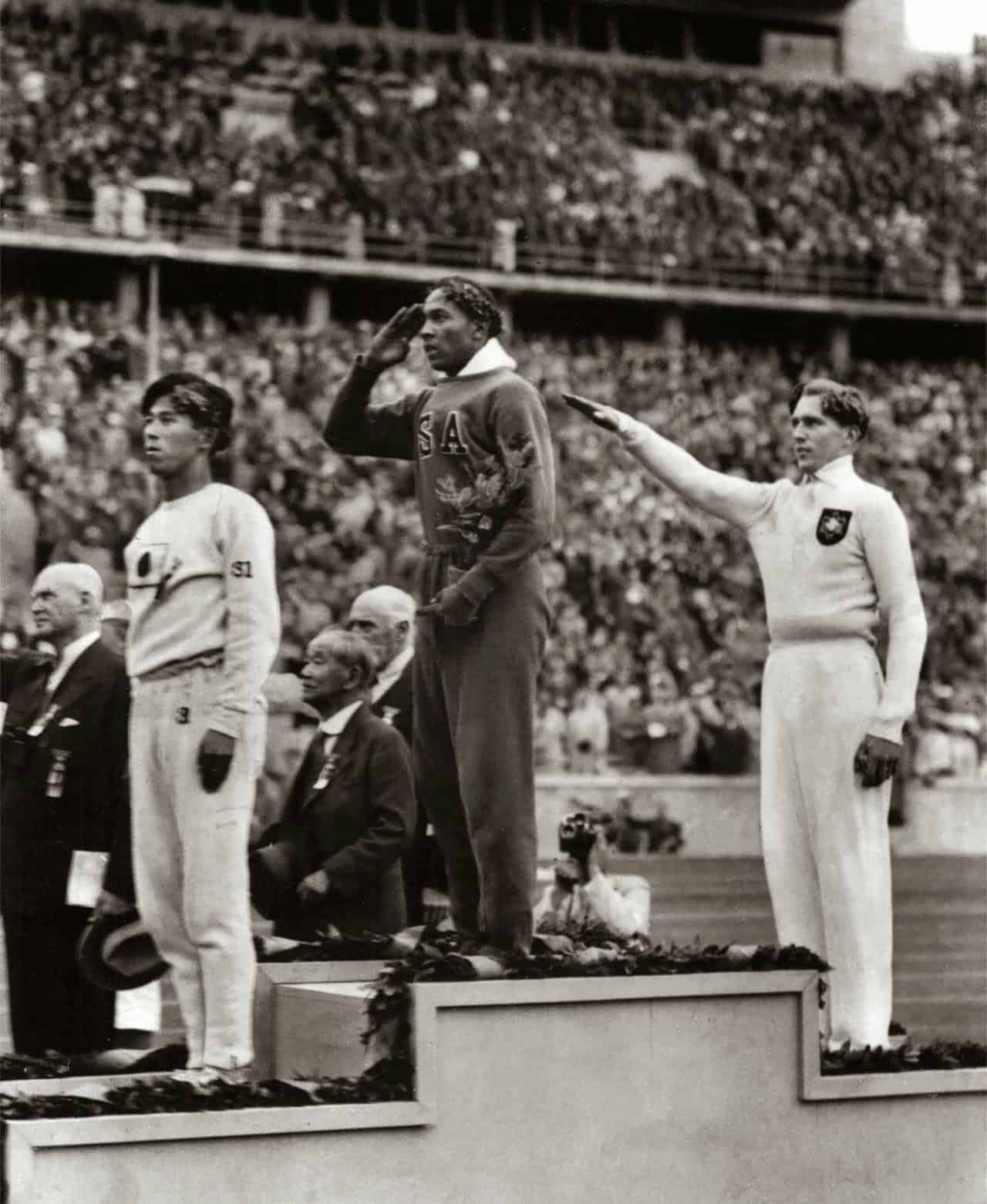
Jack Johnson became the first Black heavyweight champion of the world in 1908, defeating Tommy Burns in Sydney. The response was the search for a “Great White Hope” to reclaim the title. When no challenger succeeded, Congress passed the Sims Act (1912) banning the interstate transport of boxing films — specifically to prevent Black Americans from watching Johnson win. He was later prosecuted under the Mann Act on fabricated charges. He fled the country. Jesse Owens won four gold medals at the 1936 Berlin Olympics under Adolf Hitler’s gaze — and returned home to a country that would not let him stay in the same hotels as his white teammates.
“I came back to my native country, and I could not ride in the front of the bus. I had to go to the back door. I couldn’t live where I wanted. Now what’s the difference?”
Jesse Owens, on returning from Berlin, 1936Black Jockeys — 15 of the First 28 Kentucky Derbies
Black jockeys dominated early American Thoroughbred racing. Isaac Murphy won three Kentucky Derbies (1884, 1890, 1891) — a record that stood for decades. Alonzo Clayton won in 1892 at age 15. By 1911, systematic exclusion had removed Black jockeys from major American racing. The sport they built and dominated was closed to them within a generation of their greatest victories.
Excluded by 1911Jack Johnson — First Black Heavyweight Champion
Johnson defeated Tommy Burns in 1908 to become the first Black world heavyweight champion. Congress passed legislation specifically targeting the distribution of his fight films. He was prosecuted under the Mann Act on charges widely understood as racially motivated. He fled to Europe to avoid prison. President Obama posthumously pardoned him in 2018 — 103 years after his conviction.
Pardoned Posthumously · 103 YearsJesse Owens — Four Gold Medals in Hitler’s Berlin
Owens won four gold medals at the 1936 Berlin Olympics — 100m, 200m, long jump, 4x100m relay — in front of Adolf Hitler, who had used the Games to showcase Aryan supremacy. Hitler reportedly acknowledged Owens; Franklin Roosevelt did not send a congratulatory telegram. Owens returned to America, attended a reception in his honor at the Waldorf-Astoria through the service entrance, and could not stay in the hotel.
4 Gold Medals · Berlin 1936–1968
Jackie Robinson did not integrate baseball. He endured it — so that it could be said it had been done.
On April 15, 1947, Jackie Robinson took the field for the Brooklyn Dodgers — the first Black player in Major League Baseball in the modern era. Branch Rickey’s condition was that Robinson not respond to the abuse he would receive. For two years he absorbed racial taunts, spiking, beanballs, death threats, and exclusion from hotels where his teammates stayed. He responded by hitting .297, stealing 29 bases, and winning Rookie of the Year. The moral burden placed on him — to prove by his conduct that Black men deserved to play — was not placed on any white player.
Muhammad Ali — born Cassius Clay — won the Olympic gold medal in 1960, became heavyweight champion in 1964, converted to Islam, refused induction into the Vietnam War draft in 1967, and was stripped of his title and banned from boxing for three years at the peak of his career. The Supreme Court unanimously overturned his conviction in 1971. Tommie Smith and John Carlos raised their fists on the medal stand in Mexico City in 1968 — and were expelled from the Olympic Village within 48 hours.
“I am America. I am the part you won’t recognize. But get used to me — black, confident, cocky; my name, not yours; my religion, not yours; my goals, my own.”
Muhammad AliJackie Robinson — Breaking the Color Line
Robinson endured systematic abuse to integrate Major League Baseball — under the explicit condition that he not respond. He won Rookie of the Year in 1947, the batting title in 1949, and was a six-time All-Star. He retired in 1956 and immediately became active in the civil rights movement. Every MLB team retires his number — 42 — the only universally retired number in American professional sports.
MLB Color Line · 1947Muhammad Ali — Champion, Conscientious Objector
Ali won the heavyweight title in 1964, refusing induction into Vietnam service in 1967 on religious grounds. Stripped of his title, banned for three years at his peak, he returned to win the title twice more. The Supreme Court overturned his conviction 8-0 in 1971. He lit the Olympic flame in Atlanta in 1996, his hands trembling with Parkinson’s disease. Sports Illustrated named him Sportsman of the Century in 1999.
Title Stripped · 3-Year BanSmith & Carlos — The Raised Fist
Tommie Smith (gold) and John Carlos (bronze) raised black-gloved fists during the U.S. national anthem at the 1968 Mexico City Olympics — a silent protest against racial injustice in America. They were expelled from the Olympic Village within 48 hours. Smith set a world record in the 200m that day. Both were effectively blacklisted from athletics for years. The image became one of the most reproduced photographs of the 20th century.
Expelled · Blacklisted–Now
They were told they could not compete. Then they defined what competition looks like.
Serena Williams won 23 Grand Slam singles titles — the most in the Open Era — while navigating a sport that had excluded Black women entirely within living memory. She won her first title at 17 and her last at 35. She competed through injuries, health crises, and the documented racial and gender discrimination of professional tennis’s officiating and media culture. She is the standard against which the sport measures itself.
LeBron James became the NBA’s all-time leading scorer in 2023, surpassing Kareem Abdul-Jabbar’s record that had stood for 39 years. Simone Biles holds the most World Championship medals in gymnastics history — male or female — and became the first gymnast to land several skills in competition that now bear her name. Tiger Woods integrated golf’s most prestigious spaces and won 15 major championships in a sport whose governing body had a whites-only clause within his father’s lifetime.
“I really hope that they do say that I changed the game, because that means so much more to me than any of the titles.”
Serena WilliamsSerena Williams — 23 Grand Slams
Williams won 23 Grand Slam singles titles — the most in the Open Era. She won her last major while pregnant, returned from a life-threatening pulmonary embolism, and continued competing through documented hostile officiating. Her father taught her to play tennis on public courts in Compton, California. Tennis’s governing bodies had excluded Black players entirely within her parents’ generation.
23 Grand Slams · Open Era RecordColin Kaepernick — The Knee
Kaepernick began kneeling during the national anthem in 2016 to protest police killings of Black Americans. He was not re-signed after the season. No NFL team has signed him since. The protest — explicitly nonviolent and explicitly explained — ended his career. Six years later, the NFL acknowledged the protest’s validity. He has not played in the league since 2016. The connection between sports, race, and protest remains the most contested space in American athletics.
Career Ended for ProtestSimone Biles — The Greatest of All Time
Biles holds more World Championship medals than any gymnast in history — male or female — with 30 World medals and 7 Olympic medals. She has four skills named after her, each so difficult that judges initially scored them lower to discourage others from attempting them. She withdrew from the Tokyo Olympics team final to protect her mental health — and the public conversation that followed became as significant as her competitive record.
Most World Championship Medals · EverMaintained
Color Line
The Leagues That Excluded, Then Demanded
Every major American professional sport maintained formal or informal color lines well into the 20th century. The Negro Leagues — formed because Black athletes had no other option — produced players of documented excellence who were systematically excluded from the record books, the Hall of Fame, and the financial structures of professional sports for generations.
When integration finally came, it was framed as a gift — rather than the correction of a theft. The Negro Leagues were depleted of talent and collapsed. The Black-owned infrastructure of Black professional sports was dismantled in the name of integration. The players who integrated white leagues were required to absorb abuse in silence as the price of admission to sports they had already proved they could play.
The Sports Record in Our Backyard
Wendell Scott — NC Racing Pioneer
Wendell Scott of Danville, Virginia — racing in the Carolinas circuit — became the first Black driver to win a NASCAR Grand National race in 1963 at Jacksonville, Florida. The trophy was initially awarded to another driver. The record was corrected decades later. His story — competing in the South during Jim Crow in a sport dominated by white Southerners — is among the most remarkable in American sports history.
North Carolina & the Negro Leagues
North Carolina produced Negro League players and teams throughout the segregation era. The Durham Eagles, the Raleigh Giants, and other NC-based teams were part of the Black professional baseball infrastructure that sustained Black athletic competition while MLB maintained its color line. The players of those teams — their records, their careers, their excellence — are part of the Two Americas sports documentation project.
Fayetteville State University — Athletic Tradition
FSU’s athletic programs — competing in the CIAA (Central Intercollegiate Athletic Association), one of the oldest Black athletic conferences in America — represent a direct continuation of the Black athletic tradition. CIAA sports were established because Black student-athletes were excluded from white collegiate athletics. FSU’s teams have competed in football, basketball, and track for over 50 years within that tradition.
The record is incomplete.
We are completing it.
This page documents confirmed sports milestones and barriers broken. Additional entries are in research — from the Negro Leagues to present-day athletic activism. Every entry includes Chicago-style citations, primary sources, and NC local connections where documentable.