
I. The City
Timbuktu sits at the point where the Niger River bends northward toward the Sahara — a geographic position that made it, for roughly four centuries, the most important commercial and intellectual crossroads in the medieval world. To the south and west, the gold and agricultural wealth of the Mali and Songhai empires. To the north, the trans-Saharan caravan routes connecting West Africa to North Africa, the Mediterranean, and the Middle East. To the east, the Niger corridor reaching toward the trade networks of Central and East Africa. Timbuktu was not an accident of geography. It was a deliberate construction on a site chosen because everything passed through it.
The city had been a seasonal settlement of Tuareg nomads — the name itself likely derives from a Tuareg woman named Buktu who kept a well at the site — before it became a permanent settlement under the Mali Empire in the twelfth century. By the fourteenth century, under the patronage of Mansa Musa, it had become a city of approximately 100,000 people and one of the wealthiest urban centers in the medieval world. Its markets traded in gold dust, salt, kola nuts, leather goods, textiles, and books. The book trade was not a luxury appendage to the commercial economy. It was a core economic sector.
II. The Three Mosques and the University
The intellectual life of Timbuktu was organized around three mosque complexes — Sankore, Djinguereber, and Sidi Yahya — each of which functioned simultaneously as a house of worship, a school, and a center of manuscript production and commerce. Together they constituted what scholars now call the University of Timbuktu, though the institution was not organized on the European university model — it had no single administrative hierarchy, no formal graduation ceremonies, no standard curriculum. What it had was an extraordinary density of scholars, students, manuscripts, and the infrastructure to support all three.
The Sankore Madrasah was the oldest and most prestigious of the three. It was founded in 989 CE by the chief judge of Timbuktu, Al-Qadi Aqib ibn Mahmud ibn Umar, who financed its construction and endowment from his personal wealth. This date is significant: 989 CE is older than Oxford (which began teaching around 1096–1167 CE), older than the Sorbonne (founded 1257 CE), older than Cambridge (1209 CE), older than the University of Bologna (1088 CE, which claims to be the oldest European university in continuous operation — Sankore predates it by nearly a century). The only university older than Sankore that is still in continuous operation is Al-Qarawiyyin in Fez, Morocco — itself founded in 859 CE by Fatima al-Fihri, a North African woman. The oldest universities in the world are African.
By the fifteenth century, the three mosque complexes of Timbuktu together enrolled approximately 25,000 students from across the Islamic world — from West Africa, from North Africa, from the Arabian Peninsula, from Persia, from Andalusia. In a city of approximately 100,000, one in four residents was a student. The faculty were recognized by their peers in Cairo, Tunis, Fez, and Mecca as equals — and Timbuktu scholars were regularly appointed as professors at institutions across the Islamic world. The city’s intellectual reputation was not a local claim. It was a judgment of the international scholarly community.
III. The Manuscripts
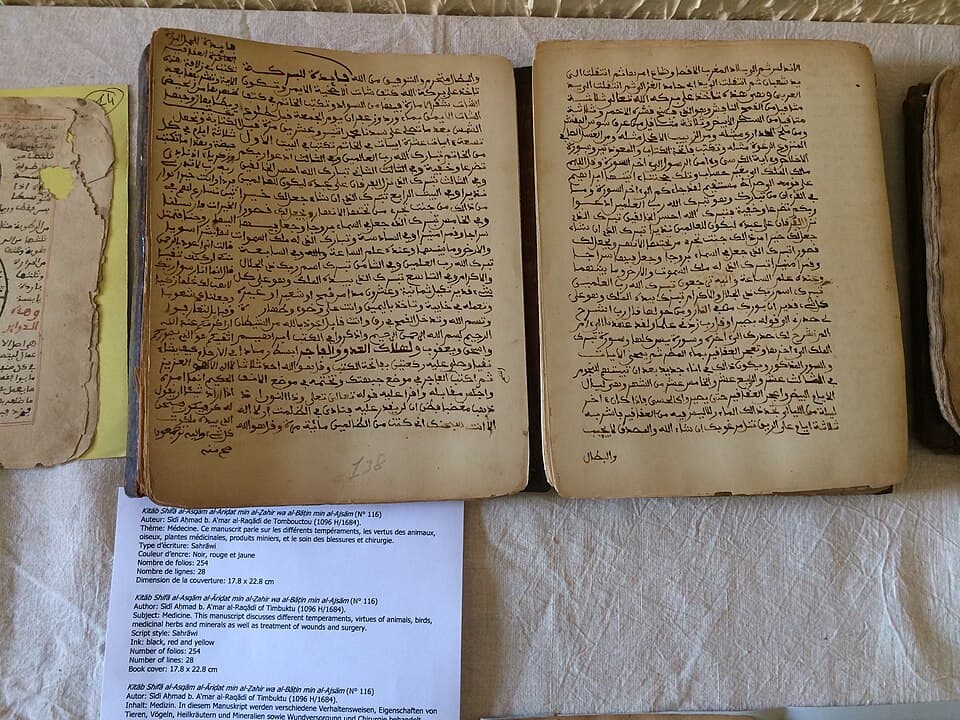
The manuscripts of Timbuktu are the most concrete, most physically surviving evidence of the scale of the city’s intellectual life — and the most persistently ignored in popular Western accounts of African civilization. Estimates of the total manuscript holdings in Timbuktu at the city’s intellectual peak range from 400,000 to 700,000 volumes, held across the three mosque libraries and in private family collections. The range reflects both the genuine difficulty of counting dispersed private holdings and the ongoing work of manuscript recovery and cataloging that continues to the present day.
The subject range of the manuscripts is the subject range of a fully developed research university: astronomy (detailed star charts, ephemerides, calculations of planetary motion), mathematics (algebraic and geometric treatises, arithmetic), medicine and pharmacology (clinical descriptions, pharmaceutical recipes, surgical procedures), jurisprudence (Islamic law and commentary, legal cases and precedents), theology and Quranic commentary, history (including local histories of West African kingdoms that are primary sources for modern historians), geography, music theory, ethics, governance, agriculture, and poetics. Many manuscripts are bilingual — written in Arabic and one or more West African languages including Songhay, Fulfulde, Soninke, and Bambara, using the Arabic script adapted for those languages. The adaptation of the Arabic script for West African languages — called Ajami — is itself a linguistic and cultural achievement of the first order.
The physical manuscripts were produced in a professional economy: scribes, calligraphers, papermakers, binders, and a commercial market in which manuscripts were bought, sold, loaned, and inherited. At certain periods in the fifteenth and sixteenth centuries, manuscripts traded at higher value per unit weight than the gold that funded the city’s commercial wealth. The book, in Timbuktu, was literally more valuable than gold.
IV. Ahmad Baba — The Scholar the Invasion Tried to Erase
Ahmad Baba al-Timbukti (1556–1627) was the most celebrated scholar in the history of the University of Timbuktu and one of the most significant African intellectuals of the early modern period. He was born into a family of scholars in Araouane and educated at Timbuktu, where he eventually became the last chancellor of the University of Sankore. He was the author of more than sixty documented works — on jurisprudence, biography, grammar, theology, and history — and his contemporary reputation placed him among the foremost scholars of the Islamic world. He was not a peripheral figure in a peripheral tradition. He was a central figure in the central intellectual tradition of the medieval Islamic world.
When the Moroccan invasion force entered Timbuktu in 1591, Ahmad Baba was at his home. He refused to collaborate with the occupying force. He was arrested, his personal library of approximately 1,600 volumes was confiscated — a library representing roughly a year’s salary per volume at the manuscript market rates of the period — and he was deported in chains to Marrakesh, where he remained for fourteen years. During those fourteen years, in chains and in exile, Ahmad Baba continued to write, to teach, and to correspond with scholars across the Islamic world. The Moroccan scholarly community in Marrakesh eventually recognized his stature sufficiently to invite him to teach publicly. He did so. He continued to argue, in writing, against the enslavement of free Black Africans — his treatise Mi’raj al-su’ud (1615), written in response to a query from a scholar in the Sudan, is one of the earliest documented arguments against African enslavement on Islamic legal grounds. He was allowed to return to Timbuktu in 1608. He died there in 1627, still writing.
V. The 1591 Invasion and the Destruction
In 1591, the Sa’di dynasty of Morocco sent an army of approximately 4,000 men — equipped with firearms and including Spanish mercenaries — across the Sahara to conquer the Songhai Empire. The army was commanded by a Spaniard named Judar Pasha. The Songhai army, which was larger but armed with traditional weapons, was routed at the Battle of Tondibi. The Moroccan force entered Gao and then Timbuktu.
What followed was not a change of governance. It was an extraction. The Moroccan administration dismantled the institutional infrastructure of the city’s intellectual life: scholars were arrested or killed, libraries were confiscated or dispersed, the manuscript production economy was disrupted. Ahmad Baba was the most prominent figure deported, but he was not the only one. The Moroccan occupation lasted for decades and did not end cleanly — the force sent to conquer the Songhai eventually lost contact with Marrakesh and became a semi-autonomous power of its own, known as the Arma, who ruled Timbuktu in a state of increasing instability for two centuries. The city never fully recovered the intellectual density it had held before 1591.
The destruction was compounded by subsequent centuries of neglect, dispersal, and the specific destruction of 2012, when the jihadist group Ansar Dine occupied Timbuktu and deliberately burned a portion of the manuscript collection before being driven out by a French military intervention. UNESCO oversaw the restoration of damaged sites. The Tombouctou Manuscripts Project and the Hill Museum and Manuscript Library — in partnership with SAVAMA-DCI — have photographed more than 150,000 manuscripts to date as part of an ongoing digitization effort.
The manuscripts that survive are held in family collections, in the Ahmed Baba Institute in Timbuktu, in repositories in Morocco, and in digitized form accessible to scholars worldwide. They are primary sources. They are evidence. They constitute, in their surviving form, one of the most significant collections of pre-modern African scholarship in existence — and they represent, in their damaged and dispersed form, one of the most significant acts of cultural destruction in world history.
Long-Term Consequences
The destruction of Timbuktu’s manuscript tradition had consequences that ran in two directions simultaneously. In the immediate direction: the loss of primary source material for the history of West Africa, the dispersal of a scholarly community whose institutional continuity was broken, and the disruption of a knowledge economy that had sustained the city’s intellectual life for six centuries.
In the longer direction: the absence of the manuscript tradition from the Western scholarly account of African civilization made the Hamitic Hypothesis’s erasure of African intellectual achievement easier to sustain. If scholars were not looking at the manuscripts — and for most of the nineteenth and twentieth centuries, they were not — then the manuscripts effectively did not exist in the Western scholarly imagination. The erasure was self-reinforcing: the destruction and dispersal of the manuscripts created the conditions for their denial, and their denial prevented the scholarly effort that might have recovered them.
The recovery project of the late twentieth and early twenty-first centuries — SAVAMA-DCI, the Hill Museum and Manuscript Library, the Ahmed Baba Institute, the Tombouctou Manuscripts Project at the University of Cape Town — has broken the self-reinforcing cycle. The manuscripts are being digitized, cataloged, and made accessible. The erasure is being reversed. The record is being recovered. It was there all along.
Learn More…Timbuktu