
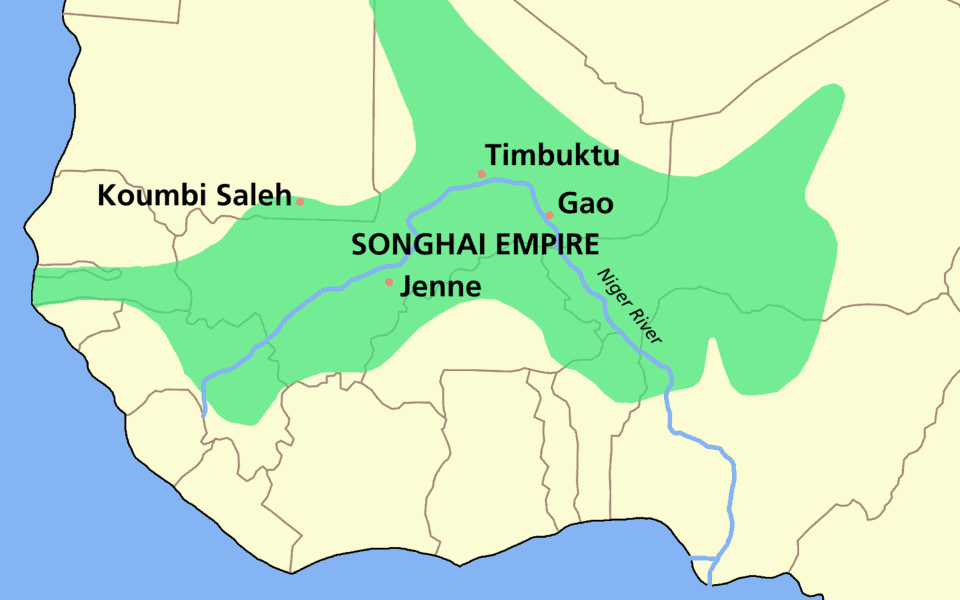
I. The Rise — Sunni Ali and the Warrior Foundation
The Songhai people had lived along the middle Niger River for centuries before the empire. Their capital, Gao, was a trading city on the Niger bend that had served as a regional commercial hub since at least the ninth century CE. Under the Mali Empire, Gao was a tributary city. In 1375, when the Catalan Atlas depicted Mansa Musa as the world’s wealthiest man, Gao was already beginning to chafe under Malian authority. By the mid-fifteenth century, as Mali weakened under internal fragmentation and external pressure, Gao was ready to move.
Sunni Ali Ber — Sunni Ali the Great — seized power in Gao in 1464 and spent the next twenty-eight years in almost continuous military campaigning. He was a military genius of the first order: a cavalry commander, a river-navy tactician, and an administrator who understood that an empire required both conquest and infrastructure. He captured Timbuktu in 1468 and Djenné in 1473 after a seven-year siege — one of the longest sieges in West African history. By the time of his death in 1492 — the same year Columbus arrived in the Caribbean — Sunni Ali had built the framework of the largest empire West Africa had ever seen. He controlled the Niger River corridor from the Malian heartland to the approaches of the Hausa states, the trans-Saharan trade routes, and the intellectual capital of Timbuktu.
His relationship with Timbuktu’s scholars was famously antagonistic. Sunni Ali was a syncretic ruler — he maintained traditional Songhai religious practices alongside nominal Islam, and the scholars of Sankore, who held rigorous Sunni orthodoxy as a standard, found him insufficiently pious. The tension between the military founder and the intellectual class he had conquered was real and documented. It was also temporary. His successor would resolve it by becoming one of the most celebrated rulers in Islamic West African history.
II. Askia Muhammad — The Philosopher King
Sunni Ali died in 1492. His son, Sunni Baru, succeeded him but was overthrown within a year by his father’s general, Muhammad Ture, who took the throne with the title Askia — a word of uncertain etymology that became the dynastic name — and is known to history as Askia Muhammad I or Askia the Great.
Askia Muhammad I ruled from 1493 to 1528 — thirty-five years that transformed the Songhai state from a military empire into a fully administered civilization. His reforms were systematic and sweeping. He standardized weights and measures across the empire, creating a unified commercial system. He appointed professional judges — qadis — to administer Islamic law in the major cities, separating judicial from executive authority. He created a professional civil service of appointed provincial governors, tax collectors, and harbor masters, replacing the ad hoc arrangements of conquest with a structured administrative state. He established royal monopolies over the gold, kola, and salt trades. He built a standing army and a river navy.
In 1496–1497, Askia Muhammad undertook the hajj to Mecca — a journey that paralleled Mansa Musa’s hajj of 1324 in its scale and in its political significance. He traveled with approximately 500 cavalry and 1,000 infantry, distributed roughly 300,000 gold pieces in alms along the route, and met with the Abbasid caliph in Cairo, who formally recognized him as the Caliph of the Bilad al-Sudan — the representative of Islamic authority in the lands of the Blacks. He returned from Mecca with the legitimacy of the Islamic world behind him and used it to consolidate his authority over Timbuktu’s scholars, who became, under his rule, the intellectual backbone of the Songhai state rather than its critics.
The scholar Ahmed Baba — who would later be deported in chains after the 1591 invasion — flourished under the Askia dynasty. The relationship between Askia Muhammad and the scholars of Timbuktu was the relationship between a sophisticated patron and a sophisticated intellectual class: mutual, productive, and foundational to the civilization that Songhai became.
III. The Scale of the Empire
At its peak under Askia Muhammad I and his successors, the Songhai Empire covered approximately 1.4 million square miles. To place this in context: the Roman Empire at its greatest extent covered approximately 1.7 million square miles. The Songhai Empire was, by territorial scale, in the same order of magnitude as the largest empire in Western history at the time of its peak. It was larger than any contemporary European state. The entire Holy Roman Empire — the dominant political entity of fifteenth-century Europe — covered approximately 400,000 square miles. Songhai was three and a half times larger.
The empire’s population is estimated at between 10 and 25 million people, organized across a diverse ethnic and linguistic landscape — Songhai, Mande, Fula, Tuareg, Hausa, and others — administered through a system that the contemporary Arabic chronicler al-Sadi, writing in his Tarikh al-Sudan, described as effectively functioning: taxes collected, justice administered, trade protected, roads patrolled.
The gold and salt trades that had funded Mali now funded Songhai. Timbuktu remained the intellectual capital of the empire and one of the wealthiest cities on Earth. The trans-Saharan caravans continued to move gold north and manufactured goods south. The Niger River served as the empire’s internal highway, with a royal fleet maintaining commercial and military control of the waterway.
IV. The Comparison That Matters
In 1492 — the year Columbus arrived in the Caribbean and Sunni Ali died — the largest city in Europe was Paris, with a population of approximately 200,000. London had approximately 75,000 people. Timbuktu, within the Songhai Empire, had approximately 100,000 — and was the center of an intellectual tradition holding between 400,000 and 700,000 manuscripts. The year that Europe “discovered” the Americas was the year the world’s largest non-Asian empire was transferring power between its first and second great rulers.
In 1500 CE — when the Songhai Empire was at or approaching its administrative peak under Askia Muhammad — Portugal had a population of approximately 1.5 million. Spain had approximately 6 million. The entire population of England was approximately 3 million. The Songhai Empire’s population was larger than any individual European nation-state of the period, administered through a system of governance that was, by the account of contemporary Arabic observers, more effectively organized than most of its contemporaries.
This is the comparison that the standard history curriculum does not make. The civilization that was targeted by the Atlantic slave trade — whose people were extracted and shipped across the ocean to build the American economy — was not a civilization of villages and subsistence agriculture. It was one of the most sophisticated administrative states on Earth.
V. The Destruction — 1591
The Songhai Empire was destroyed in less than an hour.
On March 13, 1591, at the Battle of Tondibi, a Moroccan army of approximately 4,000 men — commanded by the Spaniard Judar Pasha and equipped with arquebuses and cannon — met the Songhai army, which numbered in the tens of thousands but was armed with traditional weapons: cavalry, infantry, and a rumored deployment of cattle intended to stampede the enemy lines. The cattle stampeded backward. The Moroccan firearms routed the Songhai cavalry. The Songhai commander, Askia Ishaq II, fled the field. The battle that ended the largest empire in West African history lasted approximately one hour.
The defeat was not a consequence of civilizational weakness. It was a consequence of the firearms differential — a technology gap that had opened in the decades since Portuguese merchants had introduced firearms to the North African and West African coast. The Songhai Empire had not acquired arquebuses in sufficient quantity to match the Moroccan force. The battle was decided by metallurgy and supply chains, not by the relative sophistication of the two civilizations. The civilization that lost at Tondibi was administratively and intellectually more sophisticated than the one that won. It lost because the other side had guns.
The Moroccan victory at Tondibi did not produce a successor empire. The occupying force — the Arma — gradually lost contact with Marrakesh and became a local power ruling a fragmented territory. The trans-Saharan trade routes were disrupted. Timbuktu’s intellectual life was shattered by the 1591 invasion and the deportation of its scholars. The political vacuum left by Songhai’s destruction was filled, across the following century, by smaller and weaker states — and by the Atlantic slave trade, which expanded dramatically into the power vacuum that Songhai’s collapse created. The people of the former Songhai Empire — Mande, Fula, Songhai, Hausa, Wolof — became, in disproportionate numbers, the enslaved people of the American plantation economy.
The civilization that built the largest empire in West African history was destroyed in less than an hour by a technology gap. Its people were then enslaved and transported to build the wealth of a civilization that would spend five centuries insisting they had never built anything worth taking.
Long-Term Consequences
The collapse of Songhai removed the last major political stabilizing force in West Africa before the full expansion of the Atlantic slave trade. The smaller successor states and the fragmented Arma rule that followed were unable to resist the coastal slave-raiding and slave-trading networks that expanded inland across the seventeenth and eighteenth centuries. Historians of the Atlantic slave trade — including Paul Lovejoy and Patrick Manning — have documented that the political fragmentation following Songhai’s collapse contributed directly to the conditions that made mass enslavement possible. Songhai did not fall into the slave trade. The slave trade expanded into the space Songhai’s fall had created.
Learn More…Songhai_Africas_Largest_Empire