
What Happened
In approximately 3,100 BCE, the ruler known as Narmer unified the communities of the Upper and Lower Nile into a single political entity with a capital at Memphis, a professional administrative bureaucracy, a writing system capable of recording history and law, and a religious tradition that would persist, largely intact, for three thousand years. This was not a village. It was a state — the world’s first nation-state, by the consensus of contemporary archaeology. It preceded the Minoan civilization of Crete by five hundred years. It preceded Classical Greece by twenty-seven hundred years. It preceded Rome by three thousand years.
The civilization that Narmer founded called itself Kemet — from the Egyptian km.t, meaning “the Black Land,” a reference to the dark, fertile soil of the Nile floodplain. The name carries a weight the translation alone cannot hold. The people who built the Old Kingdom, who quarried and raised the pyramids of Giza, who wrote the Pyramid Texts — the oldest religious corpus in the world — who codified the principle of Ma’at (truth, justice, cosmic order) as the foundation of their legal and spiritual life, called themselves the people of the Black Land. The word was theirs. The erasure of it came later.
Historical Context
The geography of Kemet’s origin is African in every sense. The Nile flows north from its headwaters in present-day Ethiopia, Uganda, and Sudan — carrying with it the volcanic silt that made the Nile delta the most productive agricultural land in the ancient world. The populations that built Kemet migrated east from the drying Sahara beginning around 5,000 BCE, bringing with them the cattle-herding traditions, the spiritual practices, and the social organizations that had developed during the African Humid Period. Kemet was not a Mediterranean civilization that happened to be located at the edge of Africa. It was an African civilization that happened to be located at the intersection of Africa and the Mediterranean.
The evidence is in the population itself. Forensic analysis of ancient Egyptian skeletal remains, ancient Egyptian artistic self-representation, and the genetic record of modern Northeast African populations consistently support the understanding that the people of ancient Egypt — at least through the New Kingdom — were physically and culturally continuous with sub-Saharan African populations. The ancient Greek historian Herodotus, writing in the fifth century BCE, described the Egyptians as having “dark skin and curly hair.” He was not making a political point. He was describing what he saw.
Who Was Affected — and Who Built It
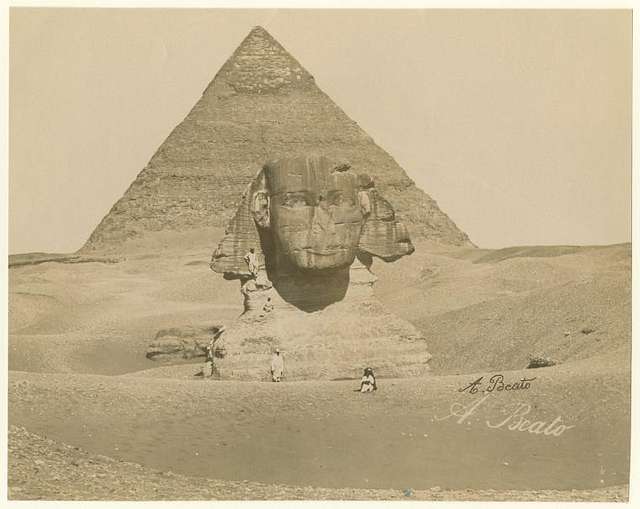
The Old Kingdom (c. 2,686–2,181 BCE) produced the pyramids. The Great Pyramid of Giza, completed around 2,560 BCE under the pharaoh Khufu, remained the tallest structure on Earth for 3,800 years — until the completion of the Lincoln Cathedral in England in 1311 CE. It was constructed from approximately 2.3 million stone blocks averaging 2.5 to 15 tons each, aligned to true north with a precision of 0.05 degrees, on a base level to within 2.1 centimeters across its entire 230-meter span. The workforce that built it was not enslaved, as nineteenth-century European scholarship assumed — archaeological excavations of the workers’ village at Giza, conducted by Zahi Hawass beginning in 1990, documented a housed, fed, medically treated professional labor force with its own cemeteries and administrative records.
The New Kingdom (c. 1,550–1,070 BCE) produced the temples of Karnak and Luxor, the Valley of the Kings, the reign of Hatshepsut (one of history’s most successful female rulers), the military campaigns of Ramesses II, and the theological revolution of Akhenaten, who briefly imposed a form of monotheism — the worship of the Aten — on the Egyptian state. Akhenaten’s monotheism predates the Hebrew Bible’s monotheism by several centuries. The intellectual and spiritual traffic between Kemet and the emerging traditions of the ancient Near East was constant, reciprocal, and foundational.
The 25th Dynasty (c. 747–656 BCE) is a fact that the erasure of Kemet from African history requires to be most aggressively forgotten. The 25th Dynasty was Kushite. Its pharaohs — Piye, Shabaka, Shebitku, Taharqa, and Tantamani — came from the Kingdom of Kush in present-day Sudan. They were Africans from south of Egypt who conquered Egypt, reunified it after a period of fragmentation, and governed it for nearly a century. Taharqa, the most celebrated of the Kushite pharaohs, built monuments at Karnak, conducted military campaigns in the Levant, and appears in the Hebrew Bible (2 Kings 19:9) as a king the Assyrians took seriously. The Bible describes him as a king of Ethiopia. He was a king of Kush — an African king governing Africa’s greatest civilization — who has been systematically obscured by the same scholarship that extracted Kemet from African history.
Long-Term Consequences
The consequences of Kemet run in two directions. The first is the direct civilizational lineage. Greek philosophy — Thales, Pythagoras, Plato — traveled to Egypt and studied there. The ancient Greeks said so themselves. Pythagoras spent twenty-two years in Egypt, by the account of the Greek historian Iamblichus. Plato studied at Heliopolis. The mathematical and philosophical tradition that Europe later claimed as the sole origin of Western civilization drew directly from the Egyptian intellectual tradition. That debt has been systematically minimized since the eighteenth century.
The second consequence is the erasure itself. Beginning in the early nineteenth century and solidifying by the 1850s, a body of European scholarship known as the Hamitic Hypothesis systematically reclassified Kemet as non-African, attributing its achievements to a hypothetical light-skinned “Hamitic race” of external origin. The hypothesis was not science. It was a racial doctrine constructed in the service of slavery and colonialism — the intellectual requirement of a civilization that had decided Africans could not have built anything and needed an explanation for the pyramids. The hypothesis was formally demolished by the work of Cheikh Anta Diop, whose 1954 doctoral dissertation, Nations nègres et culture, marshaled the linguistic, archaeological, and anthropological evidence for Kemet’s African origin. The demolition took decades to reach the mainstream. The popular imagination has not fully caught up.
Connection to Present Day
The story of Kemet is present in Black American spiritual and cultural life in ways that predate the academic recovery. The enslaved people of the American South knew the story of Egypt from the Bible — from the Exodus, from Joseph, from Moses. “Go Down, Moses” was not an abstract spiritual. It was a coded map. The parallel between the enslaved Israelites of Exodus and the enslaved Africans of the American South was not lost on the people who sang it. The Egypt of the Bible was the Egypt of the Nile, of Pharaoh, of the most powerful civilization the ancient world had produced. Black Americans sang themselves into solidarity with the enslaved people of that Egypt — and in doing so, claimed, by spiritual right, the inheritance of Kemet’s civilization as their own. The scholars who came later — Diop, Clarke, Williams, Asante — confirmed in the academy what the spirituals had already asserted in the field.