
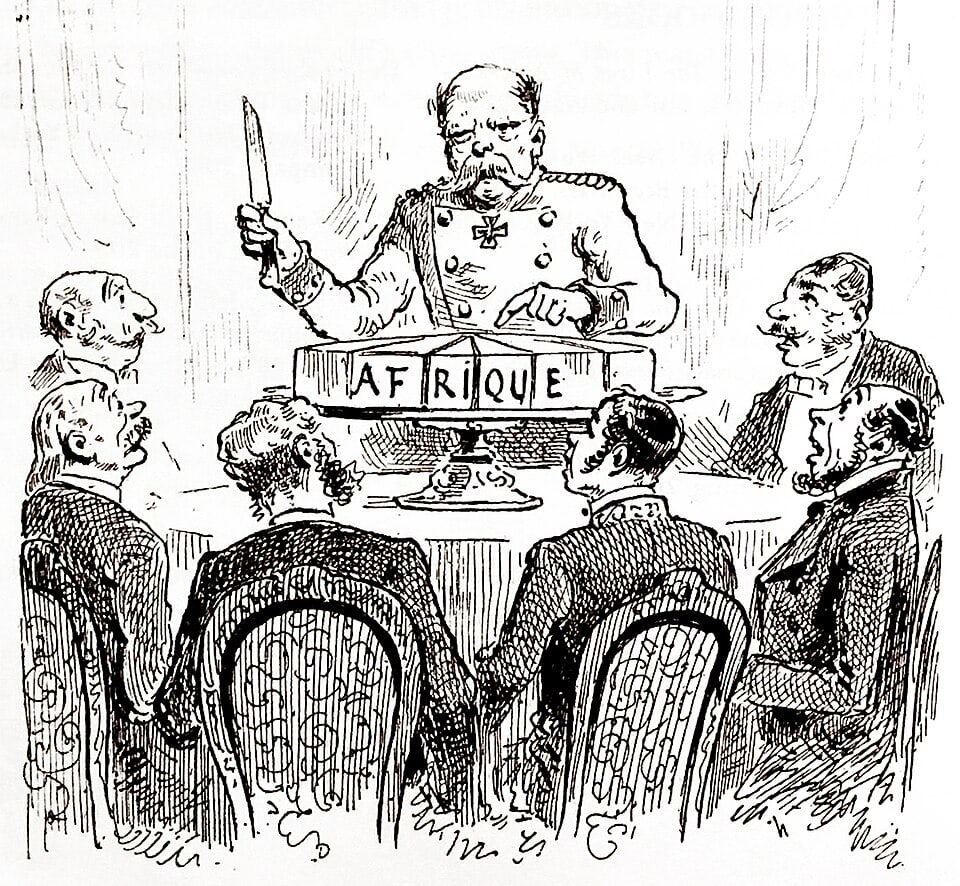
The Berlin Conference
The Partition of Africa and the Legal Framework for a Century of Extraction (1884–1885)
Fourteen nations. Zero African representatives.
The Berlin Conference — formally the West Africa Conference, convened by German Chancellor Otto von Bismarck — met from November 15, 1884 to February 26, 1885. Fourteen nations attended: Austria-Hungary, Belgium, Denmark, France, Great Britain, Italy, the Netherlands, Portugal, Russia, Spain, Sweden-Norway, the Ottoman Empire, the United States, and Germany. Not one African nation or representative was present. The continent was partitioned in the absence of its inhabitants, with the full apparatus of European international law applied to a transaction whose foundational premise — that European powers had the right to claim African territory — was never examined or challenged within the proceedings.
KEY PROVISIONS OF THE GENERAL ACT OF BERLIN (February 26, 1885)
Effective Occupation — A power must demonstrate physical presence to claim African territory. Accelerated military penetration of the continent, since powers now needed boots on the ground to make claims stick.
Congo Basin Free Trade Zone — Declared the Congo Basin open to all signatory nations. In practice handed King Leopold II of Belgium personal sovereignty over 2.3 million km² of central Africa as a private commercial venture.
Abolition of the Slave Trade — Nominal declaration of opposition to the slave trade. Served as moral cover for military intervention — any European power could justify action by characterizing an African leader as complicit in the slave trade.
Notification of Claims — Powers claiming new territory must notify other signatories. Created a diplomatic market for African territory in which African peoples had no standing and no voice.
LEOPOLD’S CONGO — THE WORST OUTCOME
The most egregious outcome of the Berlin Conference was the assignment of the Congo Basin to King Leopold II of Belgium as his personal property. Leopold represented himself at the Conference as the president of a humanitarian
organization dedicated to ending the slave trade. Bismarck accepted this representation. The Conference recognized Leopold’s “International Association of the Congo” as a sovereign entity with rights over 2.3 million square kilometers of central Africa.
What followed was the most extensively documented atrocity regime in African colonial history. Leopold’s administration imposed rubber quotas on every Congolese community, enforced through hostage-taking, mutilation, and mass killing. The severing of hands — used both as punishment and as proof that bullets had not been “wasted” — was systematic and documented in photographs taken by missionary Alice Seeley Harris. Adam Hochschild’s King Leopold’s Ghost (1998) estimates the Congo’s population fell by approximately 10 million people through death and displacement between 1885 and 1908. Leopold was forced to cede the Congo to the Belgian state in 1908 under international pressure. The structural extraction model he established has continued under different management ever since.
“Africa’s underdevelopment is not a natural condition. It is a produced one — manufactured through the deliberate dismantling of African economic systems and their replacement with extraction structures serving European economies.” — Walter Rodney, How Europe Underdeveloped Africa, 1972.
ONGOING CONSEQUENCES — SELECTED CASES
The borders drawn in the Conference’s aftermath produced conflicts still active as of 2026.
Nigeria — 1914 amalgamation of incompatible Hausa-Fulani, Yoruba, and Igbo territories. Biafran War (1967–70):
est. 1–3 million dead.
DR Congo — Leopold’s private colony: est. 10 million dead (1885–1908). Ongoing conflict: est. 5–6 million dead since 1996. Currently the largest displacement crisis in the world.
Rwanda / Burundi — Belgian colonizers hardened Hutu/Tutsi as fixed ethnic identities via identity cards. 1994 genocide: approximately 800,000 killed in 100 days.
Sudan / South Sudan — British assembled Arab north and African south in one colonial unit. Two civil wars. South Sudan independent 2011 — immediate civil war.
Somalia — Somali people divided among British, Italian, French, and Ethiopian administrations. State collapse 1991. Ongoing conflict.
Sahel — Tuareg people divided among four colonial territories. Ongoing insurgencies in Mali, Niger, Burkina Faso — Living Record.
The claim that Africa’s instability reflects African incapacity is the direct descendant of the “dark continent” narrative that justified the Conference in 1884. The evidence supports a different causal chain: borders that divided ethnic groups, destroyed governance structures, and established extraction frameworks created conditions for conflict that post-colonial states inherited without resources, institutions, or time to
resolve.
PRESENT-DAY EXTRACTION
The framework changed its name. The logic did not.
The resource extraction framework established at the Berlin Conference has been maintained through post-colonial debt structures, IMF structural adjustment programs that reduced African state capacity throughout the 1980s, and corporate tax arrangements that remove an estimated $80 billion annually from the African continent in illicit financial flows — approximately five times total foreign aid inflows. The Democratic Republic of Congo — whose territory Leopold claimed at Berlin — contains an estimated $24 trillion in untapped mineral wealth including coltan and cobalt essential for smartphones and electric vehicle batteries. Its per capita GDP is approximately $590 (2022). The minerals leave. The wealth does not stay.
NC LOCAL LENS · CUMBERLAND COUNTY / FAYETTEVILLE
The Bakongo people — the largest single ethnic group in the transatlantic slave trade, whose descendants are present throughout Cumberland County — came from the Kingdom of Kongo, which the Berlin Conference’s framework assigned to Portuguese colonial administration. The kingdom whose diplomatic correspondence is preserved in the Portuguese National Archives ceased to exist as a political entity in 1914. Fort Liberty (formerly Fort Bragg) soldiers have deployed to Africa through AFRICOM in countries — Somalia, Niger, Mali, Chad — whose political crises are structurally rooted in the Berlin Conference’s border legacy.