
What They Built, What They Defended
What Europe Divided — What Africa Had Already Built
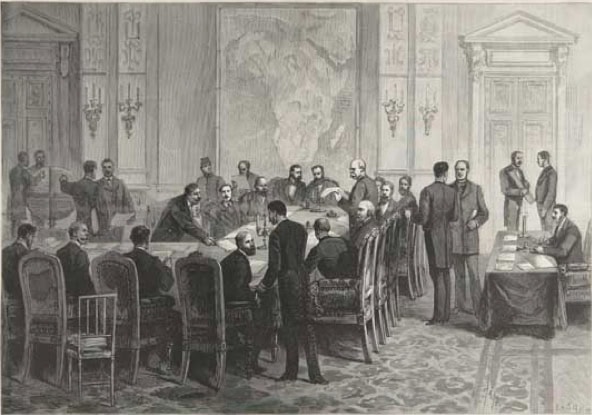
In 1884, when Bismarck convened the Berlin Conference to regulate the European partition of Africa, the continent being divided was not the primitive wilderness European propaganda required it to be. The Kingdom of Kongo had maintained diplomatic relations with Portugal since 1483 — four hundred years of documented state-to-state engagement. The Ashanti Confederacy in present-day Ghana had built a centralized state with a professional army, a sophisticated legal code, and a capital city, Kumasi, whose urban infrastructure impressed every European visitor who described it. The Zulu Kingdom under Cetshwayo had fielded an army of 40,000 disciplined soldiers who routed a British force at Isandlwana in 1879 — the largest British military defeat in Africa in the nineteenth century. The Kingdom of Ethiopia under Emperor Yohannes IV and then Menelik II had maintained its independence against Egyptian, Italian, and British pressure for decades. The Sokoto Caliphate in present-day Nigeria governed an estimated ten million people under a federated system of Islamic law and administrative practice.
These were not civilizations on the edge of history. They were at the center of their own histories when Europe arrived to redraw the map. The Berlin Conference’s fundamental premise — that Africa was terra nullius, empty land available for European claiming — was a legal fiction assembled to override a documented reality. The scholars, diplomats, and resistance fighters who responded to the partition understood that the first act of resistance was to insist on the record.
The Armies That Said No
The most direct response to the Berlin Conference was military. African states did not accept the partition as settled, and several fought it with results that permanently complicated the European colonial narrative.
Ethiopia under Menelik II delivered the clearest answer. In 1891, Menelik wrote to Queen Victoria, France, Germany, and Italy asserting Ethiopia’s sovereignty and warning that he would not accept partition. Italy, having claimed a protectorate over Ethiopia through a disputed treaty clause, sent an army of approximately 17,500 soldiers to enforce the claim. On March 1, 1896, at the Battle of Adwa, Menelik’s army annihilated the Italian column — approximately 7,000 Italian soldiers killed and 3,000 captured. Adwa was the most decisive defeat of a European colonial army by an African force in the nineteenth century. Italy recognized Ethiopian sovereignty in the Treaty of Addis Ababa the same year. Ethiopia remained independent through the entire colonial period, a fact that would electrify Black communities across the Americas and redefine Pan-African thought for generations.
The Ashanti fought four wars against British expansion in the Gold Coast between 1823 and 1900. The fourth — the War of the Golden Stool in 1900, led by Yaa Asantewaa, Queen Mother of Ejisu — was triggered when the British governor demanded the Ashanti surrender the Golden Stool, the sacred symbol of Ashanti sovereignty and collective soul. Yaa Asantewaa’s response to the Ashanti council: ‘If you the men of Ashanti will not go forward, then we will. We the women will. I shall call upon my fellow women. We will fight the white men.’ The Ashanti besieged the British fort at Kumasi for months before the uprising was suppressed. Yaa Asantewaa was captured and exiled. The Golden Stool was never handed over.
Samori Touré, founder of the Wassoulou Empire in present-day Guinea and Mali, conducted an eighteen-year military campaign against French expansion from 1882 to 1898 — relocating his entire state eastward when French pressure became untenable in the west, rebuilding his army’s weapons capacity, and engaging French forces across hundreds of miles. He was captured only through betrayal in 1898.
The Scholars Who Built the Counter-Record
While armies fought on the ground, intellectuals in Africa and the diaspora were constructing the conceptual framework that would become Pan-Africanism — the argument that African peoples across the continent and the diaspora shared a common heritage, a common oppression, and a common future that no European conference could permanently define.
Edward Wilmot Blyden, born in St. Thomas in 1832 and educated in Liberia, spent his career documenting the intellectual and spiritual achievements of African civilization against the colonial claim that Africa had no history worth preserving. His 1887 work Christianity, Islam and the Negro Race argued that African spiritual traditions contained genuine theological sophistication and that the African diaspora’s redemption lay in its reconnection to the continent rather than its assimilation into European civilization. Blyden was read by Black intellectuals throughout the Atlantic world and his arguments fed directly into the Pan-African congresses of the early twentieth century.
Alexander Crummell, born in New York in 1819 and educated at Cambridge, founded the American Negro Academy in 1897 — the first major Black scholarly organization in the United States, dedicated to the documentation and defense of Black intellectual achievement. W.E.B. Du Bois, who delivered one of the Academy’s earliest papers, called Crummell ‘the greatest of the Blacks’ and credited him as a formative intellectual influence.
The first Pan-African Conference convened in London on July 23–25, 1900 — fifteen years after the Berlin Conference had completed the partition. Organized by Trinidad-born barrister Henry Sylvester Williams, the conference produced a formal address to the European powers. The address, drafted primarily by W.E.B. Du Bois, contained the sentence that would define twentieth-century political thought: ‘The problem of the twentieth century is the problem of the color line.’ It was not a prediction. It was a diagnosis drawn directly from what the Berlin Conference had done to the world.
The NC Local Lens — AME Zion, Bishop Hood, and Fayetteville State
The Pan-African intellectual tradition was not confined to London or Liberia. It moved through Black churches, Black schools, and Black newspapers in North Carolina — including in Cumberland County — during the exact years the Berlin Conference was completing the partition.
Bishop James Walker Hood of the African Methodist Episcopal Zion Church built the institutional infrastructure of Black North Carolina in the decades following the Civil War. The AME Zion Church — whose national headquarters is in Charlotte — was among the most politically active Black institutions in the state. Hood, who served as Assistant Superintendent of Public Instruction for North Carolina during Reconstruction, understood that the education of Black children was a political act of the same order as the resistance of Menelik or Yaa Asantewaa — an assertion that the people the Confederacy had treated as property had minds worth cultivating and a civilization worth building.
The Fayetteville State Colored Normal School, founded in 1877 by Black citizens of Fayetteville who donated their own money to establish it, was operating its teacher preparation programs during the exact years of the Berlin Conference — asserting Black intellectual capacity against the colonial logic that authorized the partition. The school’s founders understood that the education of Black teachers was not separate from the question of Black civilization. It was the answer to it.
Bishop Henry McNeal Turner of the AME Church was the most vocal Pan-African advocate of the era in the American church. Turner, who served as a chaplain in the United States Colored Troops and later as Georgia’s first Black state legislator during Reconstruction, watched the Berlin Conference from the United States and wrote in 1895 that he no longer loved the American flag. Turner advocated for Black emigration to Africa not as defeat but as reclamation — the return of the diaspora to the civilization Europe was in the process of partitioning. His arguments circulated through AME and AME Zion networks across the South, including in North Carolina, shaping how Black communities in this region understood the relationship between their struggle at home and the continent being divided abroad.
What the Conference Could Not Partition
The Berlin Conference divided territory. It could not divide memory, intellectual tradition, spiritual practice, or the political determination that those things generated. The Pan-African conferences, the scholarly academies, the church networks, the military campaigns of Menelik and Yaa Asantewaa and Samori Touré — these constitute the contribution record that runs parallel to the persecution record of the partition.
The lines drawn in Berlin in 1885 would take eighty years of organized independence movements to begin erasing. Ghana achieved independence in 1957. Nigeria in 1960. The process set in motion at the first Pan-African Conference in London in 1900 — the argument that the color line was the central problem of the century and that African peoples had the capacity and the right to define their own futures — produced the twentieth century’s most consequential political transformation. The Berlin Conference was not the end of African civilization. It was the provocation that called Pan-Africanism into existence.