
THE RETURNING SOLDIER
More than 380,000 Black men served in the United States military during World War I. The 369th Infantry — the Harlem Hellfighters — fought for 191 consecutive days on the Western Front, longer than any other American unit. France awarded the Croix de Guerre to the regiment and to 171 individual soldiers. They came home to a country that had sent them to die for democracy while denying them its practice. They came home in uniform to cities that would not hire them, neighborhoods that would not house them, and a federal government that surveilled them as threats. The Department of Justice, under newly appointed Special Assistant J. Edgar Hoover, opened a unit specifically to monitor Black radicalism — and named A. Philip Randolph’s newspaper The Messenger as the most dangerous publication in America. The war had changed Black America’s expectations. The summer of 1919 was the country’s answer.
THE MASSACRES
The violence of 1919 was not spontaneous. It was organized, geographically distributed, and in many cases led by white veterans and law enforcement. In Charleston, South Carolina (May), white sailors attacked Black residents in the city’s Black business district. In Longview, Texas (July), a white mob burned Black homes and ran a Black newspaper editor out of town after he reported truthfully on the lynching of a Black man. In Washington, DC (July), white servicemen and civilians rampaged through Black neighborhoods for four days. Black residents — including veterans — armed themselves and fought back.
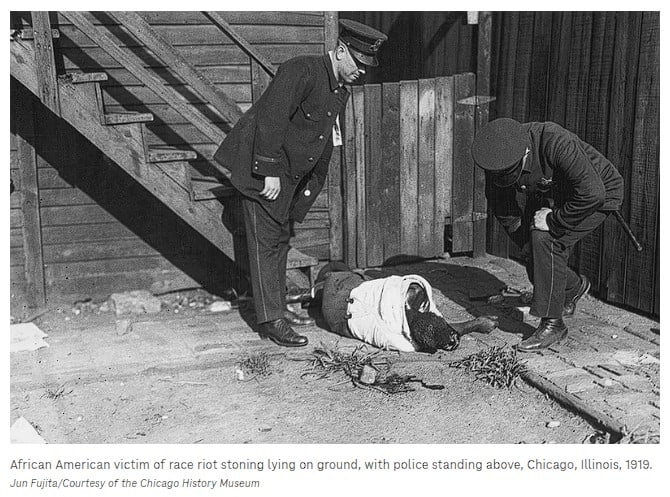
In Chicago (July–August), the worst of the urban riots: 38 dead, 537 injured, and more than 1,000 Black families left homeless after 13 days of violence triggered by the drowning of a Black teenager who crossed an invisible racial boundary in Lake Michigan. In Elaine, Arkansas (September–October), the most lethal episode: Black sharecroppers attempting to organize a union were met by a white posse and federal troops. Estimates range from 100 to 237 Black people killed. Twelve Black men were sentenced to death. The Supreme Court’s 1923 ruling in Moore v. Dempsey — that a mob-dominated trial violated due process — was the first major civil rights victory in the federal courts of the twentieth century.
THE GOVERNMENT’S ANSWER
The federal government’s response to Red Summer was surveillance, not protection. J. Edgar Hoover’s General Intelligence Division produced a report in November 1919 titled ‘Radicalism and Sedition Among the Negroes as Reflected in Their Publications.’ The report catalogued Black newspapers, Black socialist organizations, and returning Black veterans as threats to domestic order. It named Randolph, W.E.B. Du Bois, and Cyril Briggs by name. Federal troops were deployed in multiple cities — not to protect Black residents, but to suppress Black resistance. The Chicago Commission on Race Relations, established after the riot, produced a 672-page report in 1922 that documented the structural causes of racial violence: housing segregation, job discrimination, and law enforcement complicity. The report’s recommendations were almost entirely ignored.
LEGACY
Claude McKay’s sonnet ‘If We Must Die,’ written in response to Red Summer, became one of the most widely reprinted poems in African American literary history. The NAACP grew from 9,000 to 90,000 members in the months following Red Summer. Marcus Garvey’s Universal Negro Improvement Association expanded to over a million members by 1920. A. Philip Randolph accelerated his labor organizing, founding the Brotherhood of Sleeping Car Porters in 1925. The Great Migration accelerated. Black Americans who had believed that military service would produce civic inclusion concluded that different strategies were required. Red Summer did not produce despair. It produced organization.