
Content Notice

This entry contains documented historical accounts of violence, brutality, or graphic content. It is included because an accurate historical record requires it.

1921
ERA V — World Wars & Migration (1915–1954)
PersecutionSecular & Political
250Years

The Tulsa Race Massacre of 1921 — Black Wall Street Burned to the Ground

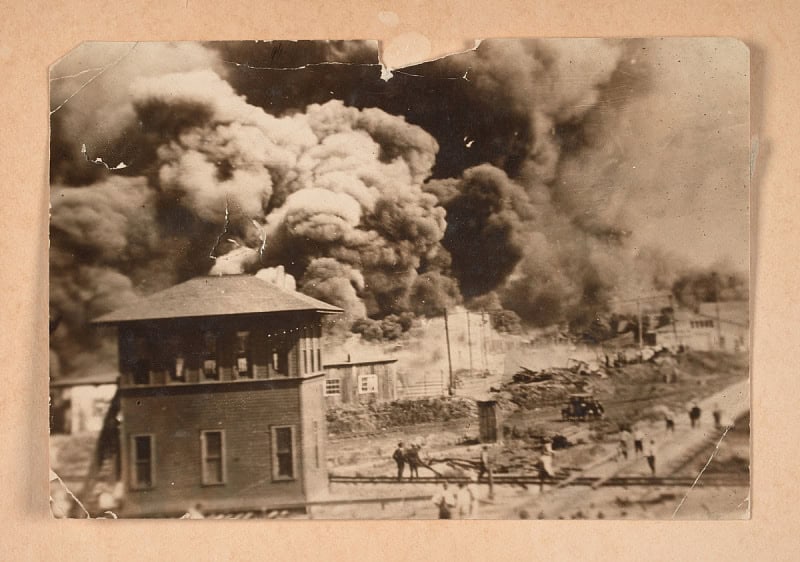
On the night of May 31, 1921, a white mob supported by the Tulsa Police Department and deputized civilians invaded the Greenwood District — the wealthiest Black community in America, known as Black Wall Street. Over 18 hours, they burned 35 square blocks, killed an estimated 300 Black residents, and left 10,000 people homeless. No one was ever charged. The city of Tulsa buried the massacre in its official record for the next seventy-five years.
— Collection of the Smithsonian National Museum of African American History and Culture, Gift of Cassandra P. Johnson Smith

The Tulsa Race Massacre followed the same template as the 1898 Wilmington Coup and Massacre — organized destruction of Black economic and political power by white mobs with government complicity. North Carolina's Black press, including the Carolina Times (Durham) and the Raleigh-based black weeklies, reported on Tulsa's destruction in 1921 and drew the explicit parallel to Wilmington. In Fayetteville and Cumberland County, Black business owners and residents recognized Greenwood's destruction as a warning: the accumulation of Black wealth and civic power made communities targets, not shields. The pattern of property destruction and suppression of Black economic enclaves documented in Tulsa directly parallels the history of Fayetteville's own Black business district along Gillespie Street.

Black Wall Street

The Greenwood District of Tulsa, Oklahoma was not a ghetto. It was a prosperous, self-contained Black city within a city — the product of legal segregation turned, by necessity and ingenuity, into economic sovereignty. By 1921, Greenwood contained over 300 Black-owned businesses: law offices, hotels, theaters, a hospital, two newspapers, a library, and a school system. Dr. A.C. Jackson, described by the Mayo Clinic as the most able Black surgeon in America, practiced there. O.W. Gurley, J.B. Stradford, and other Black entrepreneurs had built real estate empires. The district’s value was estimated at more than $1.5 million — over $25 million in 2024 dollars. Booker T. Washington had visited and called it the Negro Wall Street of America. What had been built in Greenwood was not just wealth — it was proof of what Black self-determination could produce when left unmolested. That proof was intolerable to the white Tulsa establishment.

The Massacre

The trigger was a nineteen-year-old Black shoe shiner named Dick Rowland, who rode an elevator operated by a seventeen-year-old white woman named Sarah Page on May 30, 1921. What occurred in that elevator — a stumble, a brush of the hand, nothing more — was reported to the Tulsa Tribune as an assault. Rowland was arrested. That evening, a white mob assembled at the courthouse. Armed Black men from Greenwood arrived to protect Rowland from the lynching everyone expected. A shot was fired — the origin still disputed. What followed was not a riot. It was a military assault.

Over the night of May 31 and the morning of June 1, the Tulsa Police Department and deputized white civilians — some armed by the city — moved on Greenwood in force. Private aircraft circled the district; survivors reported gunfire and incendiary materials dropped from the planes, making the Tulsa massacre one of the first instances of aerial assault on American civilians in U.S. history. Machine guns were positioned on a hill overlooking the district. More than 1,200 homes were burned. Every business, every church, every school was destroyed. Thirty-five city blocks reduced to ash. Estimates of the dead range from the official count of 36 to historian Scott Ellsworth’s documented estimate of 300 or more — most buried in unmarked graves or dumped in the Arkansas River. More than 6,000 Black residents were interned in detention camps around the city. When they were released, they returned to rubble.

Suppression and Denial

The massacre was buried almost immediately. The Tulsa Tribune removed the original article about Rowland from its archives. Tulsa’s official investigation concluded within weeks, charged no one, and the city government moved quickly to rezone Greenwood in ways that would prevent rebuilding. Insurance claims were denied — policies voided on the grounds that the destruction was the result of a riot. The Oklahoma state government did not officially investigate the massacre for seventy-five years. When the 1921 Tulsa Race Massacre Commission finally reported in 2001, it documented the scale of the destruction, confirmed city and state government complicity, and recommended reparations. The Oklahoma legislature declined to authorize them. In 2023, the last known survivor — 109-year-old Lessie Benningfield Randle — died with no reparations paid.

Legacy and Connection to Present Day

The Tulsa Race Massacre established a template: Black economic achievement, when concentrated and visible, would be met with organized destruction, and the perpetrators would face no legal consequence. The pattern was not unique to Tulsa — Rosewood, Florida (1923), the Slocum Massacre in Texas (1910), the Wilmington Coup of 1898 — but Tulsa was the largest and most documented. The centennial in 2021 renewed a national reckoning. The 1921 Tulsa Race Massacre Commission’s findings, President Biden’s centennial remarks, and ongoing litigation by the three living survivors and their descendants have kept the question of reparative justice active. As of 2024, no reparations have been paid. The land beneath the former Greenwood District — now largely occupied by the University of Tulsa and municipal infrastructure — has never been restored to its former owners’ descendants. The massacre is now embedded in Oklahoma school curriculum, but the legal and financial accountability it demands remains unresolved.


1866-1923
The American Massacre Pattern — When Black Achievement Was Met With Organized Destruction
1898
The Wilmington Massacre of 1898 — The Only Coup d'État in American History
1921
The Tulsa Race Massacre of 1921 — Black Wall Street Burned to the Ground

On the night of May 31, 1921, a white mob supported by the Tulsa Police Department and deputized civilians invaded the Greenwood District — the wealthiest Black community in America, known as Black Wall Street. Over 18 hours, they burned 35 square blocks, killed an estimated 300 Black residents, and left 10,000 people homeless. No one was ever charged. The city of Tulsa buried the massacre in its official record for the next seventy-five years.

1898
The Wilmington Massacre of 1898 — The Only Coup d'État in American History
1919
The Red Summer of 1919 — When Black Soldiers Came Home and White America Responded With Terror

In the summer of 1919, the United States returned from the battlefields of Europe and turned its violence on Black communities at home. In at least 26 cities, white mobs attacked Black neighborhoods, Black veterans, and Black homes. The federal government watched, documented, and in some cases participated. The NAACP called it the Red Summer. The 20,000 Black men and women who joined the NAACP in the months that followed called it a declaration.

Sources & Citations

1. Oklahoma Commission to Study the Tulsa Race Riot of 1921. Tulsa Race Riot: A Report by the Oklahoma Commission to Study the Tulsa Race Riot of 1921. Oklahoma City: Oklahoma Commission, 2001. [Source] governmentOklahoma Historical Society
2. Hirsch, James S. Riot and Remembrance: The Tulsa Race War and Its Legacy. Boston: Houghton Mifflin, 2002. peer_reviewed
3. Messer, Chris M., Thomas E. Shriver, and Alison E. Adams. 'The Destruction of Black Wall Street: Tulsa's 1921 Riot and the Eradication of Accumulated Wealth.' American Journal of Economics and Sociology 77, no. 3–4 (2018): 789–819. peer_reviewedAJES
4. Coates, Ta-Nehisi. 'The Case for Reparations.' The Atlantic, June 2014. [Source] reputableThe Atlantic
5. Tulsa World. 'Tulsa Race Massacre Coverage, 1921.' Contemporaneous reporting. Tulsa World Archive. [Source] newspaperTulsa World Archive
6. Johnson, Hannibal B. Black Wall Street: From Riot to Renaissance in Tulsa's Historic Greenwood District. Fort Worth: Eakin Press, 1998. peer_reviewed
7. Equal Justice Initiative. 'Tulsa Race Massacre (1921).' Equal Justice Initiative, 2020. [Source] reputableeji.org
← The Red Summer of 1919 — When Black Soldiers Came Home and White America Responded With Terror
Return to Timeline
Julian Abele — The Black Architect Who Designed Duke University and Lived in the Shadows →