
I. The World Before the War
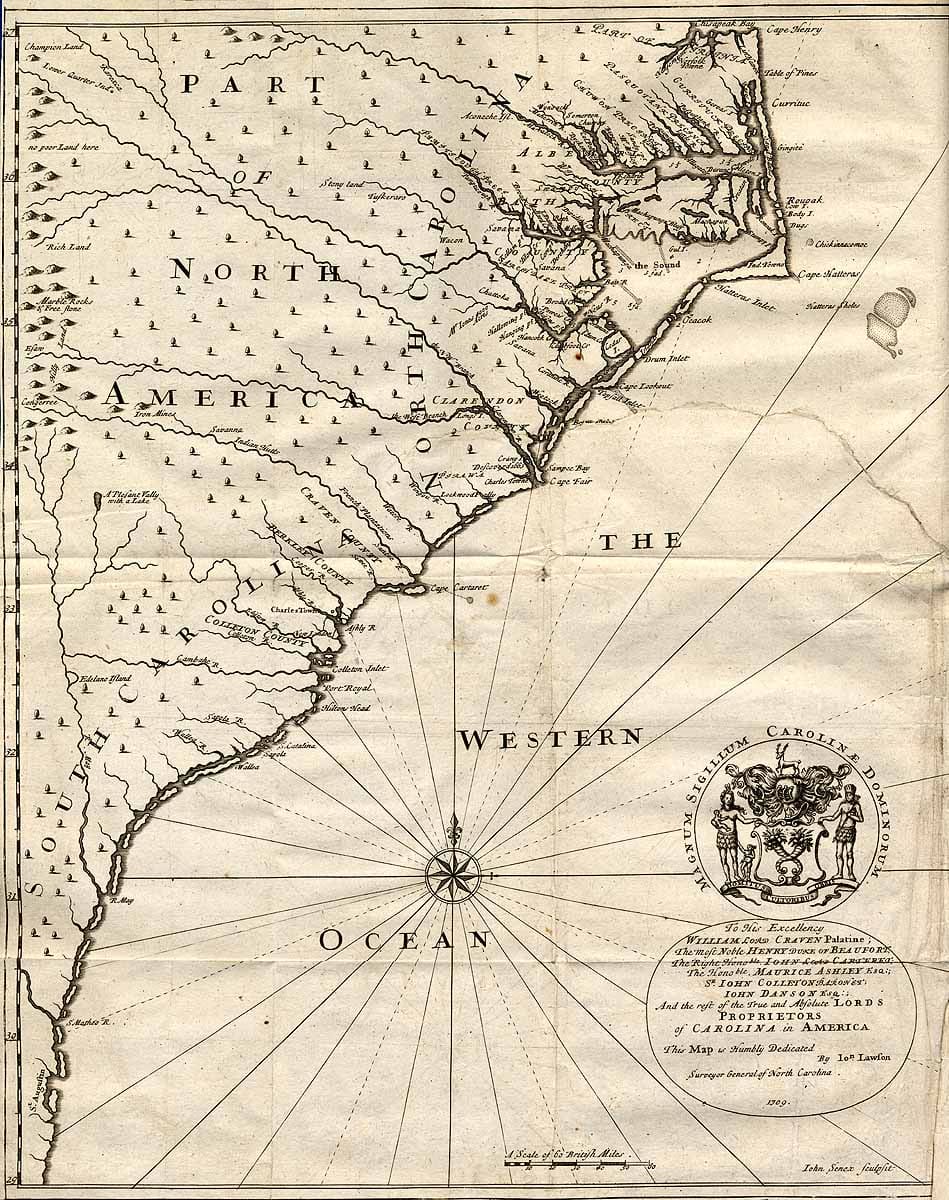
The Skarure — the people Europeans called the Tuscarora — were an Iroquoian-speaking nation whose pre-contact territory extended from the coastal plain of eastern North Carolina westward through the Piedmont, encompassing present-day Cumberland, Robeson, Sampson, Bladen, Brunswick, New Hanover, Johnston, Wayne, Lenoir, Craven, Jones, and Onslow counties. John Lawson’s 1709–1710 survey of the Carolina interior — one of the most detailed primary documents of pre-war Indigenous North Carolina — documented Skarure settlements across this territory: fifteen towns, active agricultural fields, a population he estimated at approximately 1,200 warriors, suggesting a total population of perhaps 5,000–6,000 people organized in a sophisticated governance structure with a council of chiefs and established diplomatic protocols.
The Skarure had not been at war with the colonial settlements before 1711. They had been at diplomacy. Through the late seventeenth and early first decade of the eighteenth century, the Skarure leadership had attempted to negotiate with colonial authorities the terms under which European settlers could occupy portions of their territory — seeking formal recognition of land boundaries, regulation of the colonial trade that had become economically integrated into Skarure life, and protection against the enslavement of Skarure people by colonial traders who were raiding Indigenous communities and selling their members into the Atlantic slave trade.
The colonial government of North Carolina — then a proprietary colony governed by the Lords Proprietors of Carolina — did not deliver on these negotiations. What it delivered instead was a decade of encroachment, exploitation, and the steady erosion of the diplomatic framework the Skarure had constructed.
II. The Causes — Encroachment, Enslavement, and the Failure of Diplomacy
The immediate causes of the Tuscarora War are documented in the contemporary colonial and missionary record — primarily in the accounts of the Swiss colonist Christoph von Graffenried, who had recently settled with a party of Swiss and German Palatine immigrants in the region, and in the report of John Barnwell, the South Carolina militia officer who would lead the first military response against the Skarure.
Land encroachment was the structural cause. European settlers, without formal purchase or treaty acknowledgment, were occupying Skarure agricultural fields and hunting territories. Settlers’ livestock destroyed Skarure crops. Colonial traders operating in Skarure territory were systematically cheating their trading partners and, in a number of documented instances, kidnapping and selling Skarure people into slavery. The traffic in enslaved Indigenous people — a practice that had been ongoing in the Carolinas since the late seventeenth century and would continue through the Tuscarora War and beyond — represented the most acute violation of the diplomatic terms the Skarure had sought to establish.
The Skarure leadership had attempted, on multiple documented occasions, to bring their grievances to the colonial government. In 1710, a Skarure delegation traveled to Pennsylvania — then governed by William Penn’s Quaker administration, which maintained a relatively principled approach to Indigenous relations — to request Pennsylvania’s intercession and, possibly, to explore whether the Skarure could migrate north and join the Haudenosaunee Confederacy. Pennsylvania sent representatives to North Carolina on the Skarure’s behalf. The North Carolina colonial government did not respond in good faith.
John Lawson, whose 1709–1710 survey had documented Skarure life in some of the most detailed terms available, was himself killed in September 1711 — captured and executed along with Christoph von Graffenried as the war began. Von Graffenried, who was held for a period and then released, later recorded that Lawson had been killed for allegedly violating a territorial boundary during his survey. The execution of a colonial explorer who had just published a detailed map of Skarure territory — weeks before the war’s opening — is not a coincidence that the historical record has fully explained.
III. The War — September 1711 to April 1713
On the night of September 22, 1711, the Skarure, coordinating with allied nations including the Coree, Neusiok, Pamlico, and Bear River peoples, launched simultaneous attacks on colonial settlements along the Neuse and Trent rivers. Approximately 130 colonists were killed in the opening night. The attacks were precise, coordinated, and targeted at the specific communities that had been most directly responsible for the encroachment and enslavement that had provoked the war. Von Graffenried, who had arrived recently and had not participated in the prior abuses, was taken prisoner and later released after negotiating separately with the Skarure leadership — an act of diplomatic discrimination that the Skarure leadership maintained even in the opening phase of the war.
The colonial government of North Carolina had virtually no military capacity. It appealed to the neighboring colony of South Carolina for military assistance. South Carolina sent Colonel John Barnwell with a force of approximately 30 colonial militia and between 500 and 1,000 Yamasee and allied Indigenous warriors. Barnwell’s first campaign, in January–April 1712, captured the Skarure fortified town of Neoheroka and forced a ceasefire. The ceasefire was almost immediately violated — by Barnwell, who seized Skarure people as slaves after the agreement. The war resumed.
South Carolina sent a second force in 1713 under Colonel James Moore, son of a former South Carolina governor. Moore’s army — again primarily composed of Indigenous allies, including Cherokee, Creek, and Catawba warriors — attacked the primary Skarure fortification at Fort Neoheroka in March 1713. The battle lasted several days. When the fort was breached, between 800 and 1,000 Skarure people were killed or captured. The captured were enslaved. Contemporary accounts from Moore’s own reports document that approximately 400 Skarure were sold into the Atlantic slave trade as a direct result of the Fort Neoheroka campaign. These were not prisoners of war in any modern sense. They were free people of a sovereign nation who had been fighting to protect their territory from encroachment — sold by the colonial government’s military force into plantation slavery.
IV. The Aftermath — Enslavement, Dispersal, and the Opening of the Cape Fear
The war formally ended in 1715. Its consequences for the Skarure were total.
The Skarure who survived the war and chose to remain in North Carolina were confined to a small reservation on the south side of the Pamlico River, in Bath County. Within a generation, colonial pressure had reduced even this reservation. By the mid-eighteenth century, it had effectively ceased to exist as a functioning territorial base.
The majority of the surviving Skarure made the decision to leave. They traveled north, through Virginia, and in 1722 were formally adopted into the Haudenosaunee Confederacy as its Sixth Nation — the Tuscarora — completing the confederacy’s expansion from the original Five Nations. The Tuscarora Nation in New York and Ontario is the direct institutional successor of the Skarure people who left North Carolina after 1715. Their departure left the Cape Fear basin politically open — without the Skarure territorial authority that had been the primary obstacle to colonial expansion inland from the coast.
Colonial settlement of the Cape Fear basin moved rapidly after the war. By the 1720s, plantations were being established along the lower Cape Fear. By the 1730s, settlement had moved inland toward the falls of the Cape Fear — the site that would become Fayetteville. The crop economy of these plantations — rice and indigo in the coastal lowlands, tobacco and later cotton inland — was built on the labor of enslaved Africans, specifically selected from the West African populations whose agricultural knowledge made them economically valuable. The land those plantations occupied was the land the Tuscarora War had opened. The labor that worked that land was the labor the Atlantic slave trade provided. The two tracks of Two Americas persecution — Indigenous dispossession and African enslavement — converge at this precise geographic and historical point: the falls of the Cape Fear River, where Cumberland County was organized in 1754, where Campbellton was established in 1762, where Fayetteville was incorporated in 1783.
V. The Skarure and the Atlantic Slave Trade
The Tuscarora War intersects the Atlantic slave trade at a point that is not widely documented in the standard curriculum. Between 1670 and 1720, the Carolina colonies were among the largest exporters of enslaved Indigenous people in the Atlantic world — a fact that has been recovered in the scholarship of Alan Gallay (The Indian Slave Trade, 2002) and Robbie Ethridge (Mapping the Mississippian Shatter Zone, 2009). The enslavement of Indigenous people was not incidental to the Tuscarora War. It was one of the structural causes of the war — the trafficking of Skarure people by colonial traders had been among the explicit grievances the Skarure leadership raised before hostilities began — and it was among the explicit consequences: the colonial military operations of 1712–1713 generated hundreds of enslaved Skarure people who were sold into the Atlantic trade.
The 400 Skarure sold after Fort Neoheroka were transported — primarily to the sugar islands of the Caribbean. Their names are not in the record. Their children’s names are not in the record. The colonial government that sold them recorded the transaction as a financial asset, not as the enslavement of the people of a sovereign nation that had been fighting to protect its territory from encroachment. The record that exists is primarily in South Carolina colonial financial accounts and in the work of scholars who have reconstructed it two centuries after the fact.
VI. What Was Destroyed and What Was Built on Its Ruins
The Tuscarora War destroyed the Skarure’s territorial base in the Cape Fear region, killed between 1,000 and 2,000 Skarure people, enslaved several hundred more, and dispersed the surviving population between a reduced NC reservation and the Haudenosaunee Confederacy in the north. It opened the Cape Fear basin to plantation agriculture.
What was built on the ruins:
The plantation economy of the lower and middle Cape Fear — rice, indigo, tobacco, and later cotton — which was operated with the labor of enslaved Africans on the land that Skarure territorial authority had previously protected from colonial settlement.
The town of Campbellton (1762), which became Fayetteville (1783), which became the seat of Cumberland County — organized in 1754 from the territory opened by the Tuscarora War.
The antebellum slave market of Fayetteville — the market on Hay Street where Omar ibn Said was sold in 1807 — which operated on land where Skarure people had farmed for generations before the war removed them.
The Two Americas archive holds all three in the same frame. The Skarure’s dispossession and the enslaved Africans’ arrival are not separate stories. They are the same story — the story of how the land was taken and what was done with it after.
Long-Term Consequences
The long-term consequences of the Tuscarora War run forward to the present. The Lumbee Tribe of North Carolina — descended in part from Skarure and related peoples who remained in the region after 1715 — has been fighting for full federal recognition for decades, on land that was Skarure territory before the war. The Tuscarora Nation in New York — the Sixth Nation of the Haudenosaunee Confederacy — maintains its sovereign existence and its connection to North Carolina as the place of origin. The land between the Lumber River and the Cape Fear River — the land where Fayetteville sits, where Cumberland County was organized, where the enslaved people of the antebellum plantation economy worked — is the direct product of what the Tuscarora War destroyed and what the plantation economy built in its place.
Learn More… The_Tuscarora_War_1711_1715