
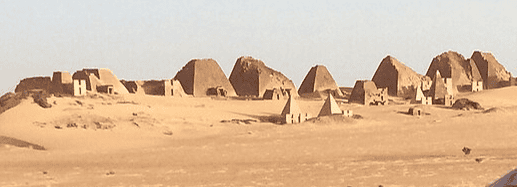
I. The Kingdom of Kush — 2,500 BCE to 350 CE
The Kingdom of Kush is older than the classical world by more than two thousand years. Its earliest phase — the Kerma culture of the upper Nile, in present-day northern Sudan — dates to approximately 2,500 BCE, contemporary with the Old Kingdom of Egypt. Kerma was not a satellite of Egypt. It was a rival. Egyptian texts describe Kerma as a formidable enemy requiring military campaigns to contain. The Kerma kings were buried in large tumuli with grave goods of extraordinary quality — gold jewelry, pottery, and the bodies of sacrificed retainers — demonstrating a sophisticated court culture entirely independent of Egyptian influence.
By 1700 BCE, Kerma controlled the upper Nile corridor and temporarily occupied parts of Upper Egypt during the period of Egyptian weakness known as the Second Intermediate Period, when the Hyksos occupied the Delta. The Kerma kingdom held Elephantine, the traditional southern boundary of Egyptian territory, and raided north. Egypt was, at this moment, being pressured from both directions by non-Egyptian powers — and the southern pressure came from an African kingdom whose sophistication the standard historical account has systematically minimized.
After Kerma’s absorption into the New Kingdom of Egypt around 1,500 BCE, the Kushite tradition did not end. It reorganized. By the eighth century BCE, a new Kushite state centered at Napata — the site of the sacred mountain Jebel Barkal, where the Kushites believed Amun resided — had grown powerful enough to move north. The Kushite king Piye invaded Egypt in 728 BCE, defeated the fragmented Egyptian princes, and established the 25th Dynasty. His successors — Shabaka, Shebitku, Taharqa, and Tantamani — governed all of Egypt and built monuments that stand today. Taharqa’s construction projects at Karnak and his military engagements in the Levant made him one of the most powerful rulers of the seventh century BCE anywhere on Earth. The Hebrew Bible names him. The Assyrian records describe him with a combination of respect and alarm that the Assyrian records did not often extend to anyone.
The 25th Dynasty ended when the Assyrian Empire invaded Egypt in 667 BCE, deploying iron weapons and a military machine that overwhelmed the Kushite armies. The Kushite kings withdrew south. They did not collapse. The Kushite state relocated its capital to Meroe, farther south on the Nile, and entered a new phase.
II. Meroe — The Iron Empire · c. 300 BCE – 350 CE
The Meroitic phase of the Kushite state lasted from roughly 300 BCE to 350 CE — a span of six and a half centuries, longer than the entire history of the United States from independence to present. Meroe, located between the Fifth and Sixth Cataracts of the Nile in present-day Sudan, became one of the ancient world’s major centers of iron production. The slag heaps at Meroe are among the largest of any ancient iron-smelting site in Africa. The iron technology produced there diffused south and west, contributing to the metallurgical traditions of sub-Saharan Africa for centuries after Meroe’s decline.
Meroe traded with Ptolemaic and then Roman Egypt, with Arabia, and with the Indian Ocean world. Meroitic queens — the Kandakes, mistranslated by Greek and Roman sources as “Candace” and misread as a personal name — governed the kingdom with documented authority. The Roman emperor Augustus attempted to extend Roman power into Meroitic territory in 24 BCE. The Meroitic army, commanded by a Kandake, defeated the Roman expedition and forced a negotiated settlement. Rome signed a treaty with Meroe. The terms were favorable to Meroe. This is in the Roman record. It is not in most American history curricula.
Meroe developed its own writing system — the Meroitic script — which remains only partially deciphered. The civilization produced hundreds of pyramids, smaller and steeper than those of Egypt, that still stand in present-day Sudan. There are more ancient pyramids in Sudan than in Egypt. This fact is almost universally unknown to people who have been educated in the American school system.
III. Aksum — The Christian Empire · c. 100 CE – 940 CE
The Kingdom of Aksum arose in the northern highlands of present-day Ethiopia and Eritrea, centered on the city of Aksum. By the first century CE, it was a major Red Sea trading power, controlling access to the trade routes between the Mediterranean world, Arabia, and India. The Aksumite economy was built on ivory, gold, obsidian, and slaves — and on the transit fees and control of the Red Sea port of Adulis, through which the products of the East flowed west and the products of the West flowed east.
The Periplus of the Erythraean Sea, a first-century CE Greek merchant manual, describes the Aksumite king as a trader who personally conducted commerce with visiting merchants — a level of royal commercial engagement unusual in the ancient world. The anonymous author describes Adulis as a prosperous port with a sophisticated market. Aksum was, by the Periplus’s account, one of the great commercial hubs of the ancient world.
In approximately 330 CE, the Aksumite king Ezana converted to Christianity — making Aksum one of the first states in the world to adopt Christianity as its official religion. This happened before the Roman Empire fully embraced Christianity under Theodosius in 380 CE. The Ethiopian Orthodox Church — which traces its unbroken lineage to Ezana’s conversion — is one of the oldest continuously existing Christian institutions on Earth. Its liturgical tradition, its distinctive architectural forms, its sacred text tradition including the Ge’ez language Bible, and its claim to hold the Ark of the Covenant in the Church of Our Lady Mary of Zion in Aksum, make it one of the most historically significant religious institutions in human history. It was built in Africa, by Africans, on African ground, before Rome had committed to Christianity as the state religion.
Aksum at its height was recognized by the Persian prophet Mani, writing in the third century CE, as one of the four great powers of the world — alongside Rome, Persia, and China. This judgment, made by a contemporary observer, places Aksum in the first rank of world civilizations at a moment when no European kingdom north of the Alps was remotely comparable.
The Aksumite stelae — towering obelisks of carved granite, some exceeding 30 meters in height — were engineering achievements of the first order. The largest stele ever quarried at Aksum, weighing approximately 520 tons, fell during erection, suggesting the Aksumites were pushing the limits of their engineering. The Obelisk of Aksum, looted by Mussolini’s forces in 1937 and taken to Rome, was returned to Ethiopia in 2008 after decades of diplomatic negotiation — a repatriation that stands as one of the few successful returns of looted African cultural property in the modern era.
Long-Term Consequences
The Kingdom of Kush produced the iron technology that spread through sub-Saharan Africa. The 25th Dynasty produced the documentation — in the Egyptian record, the Assyrian record, and the Hebrew Bible — of African governance of the ancient world’s greatest civilization. Meroe produced the pyramids that outnumber Egypt’s and the Kandake queens who defeated Rome. Aksum produced a Christian civilization predating Rome’s full Christianization, a literary tradition in Ge’ez that preserved texts lost elsewhere, and the Ethiopian Orthodox Church whose continuous existence connects the present to the third century CE.
All three civilizations were systematically erased from the standard Western account of human history through a combination of the Hamitic Hypothesis (which denied their African identity), the colonial mapping project (which treated sub-Saharan Africa as “prehistory”), and the simple curricular choice — made and remade in American school systems through the twentieth century — to begin the story of civilization in Greece and Rome rather than in the Nile Valley and the Horn of Africa. The erasure was not passive. It was a sequence of choices made by specific people in specific institutions with specific incentives. The corrected record is here.
Learn More…Kush, Nubia & Aksum