
I. What the Hypothesis Said
The Hamitic Hypothesis, in its mature nineteenth-century form, held that the African continent had produced two categories of people: the “Hamites” — a hypothetical race of light-skinned, Caucasian-adjacent people believed to be descended from Ham, the son of Noah — and the “Negroes,” who were held to be incapable of civilization. Wherever European explorers and scholars encountered evidence of advanced civilization in Africa — monumental architecture, written language, sophisticated governance, complex art — the hypothesis required that this evidence be attributed to the Hamites, not to the Black African populations actually present. The Black Africans, by the hypothesis’s logic, could not have built it.
The doctrine drew on the “Curse of Ham” — a misreading of Genesis 9:20–27 in which Noah curses Canaan, the son of Ham — which had been used since at least the ninth century CE to justify the enslavement of African people on theological grounds. The Hamitic Hypothesis gave this theological justification a scientific veneer. It located the curse in biology and anthropology rather than Scripture, allowing it to survive the Enlightenment’s formal rejection of theological authority and enter the modern university as empirical science.
II. The Named Scholars and Their Work
The Hamitic Hypothesis was not an anonymous cultural prejudice. It was the product of named scholars working in named institutions producing named publications. The record of its construction is available and should be read.
Johann Friedrich Blumenbach (1752–1840), the German physician and naturalist whose 1775 doctoral dissertation De generis humani varietate nativa (On the Natural Variety of Mankind) established the five-race taxonomy — Caucasian, Mongolian, Ethiopian, American, Malay — that became the foundational framework of scientific racism. Blumenbach’s taxonomy was not explicitly genocidal, and he personally believed in the common humanity of all races. But the framework he established — with “Caucasian” as the normative type from which all others deviated — was the scaffold on which the Hamitic Hypothesis was built.
Samuel George Morton (1799–1851), the Philadelphia physician whose collection of approximately 1,000 human skulls — the largest such collection in the world at his death — was used to argue for a hierarchy of racial intelligence based on cranial capacity. Morton’s measurements, published in Crania Americana (1839) and Crania Aegyptiaca (1844), purported to show that ancient Egyptians were racially distinct from sub-Saharan Africans — providing “scientific” authority for extracting Egypt from Africa. Stephen Jay Gould’s 1981 reanalysis of Morton’s data in The Mismeasure of Man demonstrated that Morton had unconsciously manipulated his measurements to support his predetermined conclusions. A subsequent reanalysis of Gould’s reanalysis, published in PLOS ONE in 2011, found that Morton’s original measurements were largely accurate but that his sample selection and interpretive framework were deeply biased. The debate over Morton’s data has continued; the consensus that his conclusions were racially motivated remains firm.
Arthur de Gobineau (1816–1882), the French aristocrat whose Essay on the Inequality of the Human Races (1853–1855) articulated the most systematic early statement of Aryan supremacy and the theory that racial mixture was the primary cause of civilizational decline. Gobineau explicitly attributed the achievements of ancient Egypt to a Hamitic race distinct from — and superior to — Black Africans. His work was the direct intellectual precursor to twentieth-century Nazi racial ideology.
Charles Gabriel Seligman (1873–1940), the British anthropologist whose Races of Africa (1930) gave the Hamitic Hypothesis its most authoritative twentieth-century statement. Seligman wrote: “The civilizations of Africa are the civilizations of the Hamites, its history the record of these peoples.” This sentence, published by a respected British academic at the Oxford University Press, appeared in a textbook used in British and American universities for decades. It is the clearest single-sentence statement of the hypothesis and of the erasure it performed.
John Hanning Speke (1827–1864), the British explorer whose account of his East African expeditions introduced the “Tutsi as Hamites” theory — attributing the relatively sophisticated governance structures of the Great Lakes region to a presumed Caucasian origin of the Tutsi people. Speke’s hypothesis, filtered through decades of Belgian colonial administration, contributed directly to the racial ideology that would produce the Rwandan genocide of 1994. The Hamitic Hypothesis did not end with footnotes. It ended with bodies.
Mortimer Wheeler (1890–1976), the British archaeologist whose early excavations at Great Zimbabwe produced the hypothesis that the site had been built by Phoenicians or other external agents — not by the ancestors of the Shona people who actually built it. The Rhodesian government, which was administering Zimbabwe as a colony, actively suppressed archaeological findings that supported African authorship of Great Zimbabwe. Scholars who published findings attributing the site to African builders — including Gertrude Caton-Thompson, whose 1931 excavations definitively established African authorship — faced institutional resistance and were marginalized.
III. The Institutions That Carried It
The Hamitic Hypothesis was not confined to fringe publications. It was embedded in the most prestigious scholarly institutions of the nineteenth and twentieth centuries.
The Encyclopaedia Britannica — the reference standard of educated Western households — carried versions of the Hamitic framework through multiple editions of the nineteenth and early twentieth centuries. The entry on “Negro” in the 1911 edition stated explicitly that the African was characterized by “a certain amount of mental inferiority” and was “thus placed at the bottom of the scale of human beings.” The 1911 Britannica was the reference work used in American public schools and libraries. It was not a curiosity. It was authoritative.
The Journal of the Royal Anthropological Institute — the flagship publication of British academic anthropology — published Hamitic Hypothesis scholarship for decades without significant challenge. The American Anthropological Association’s early publications similarly carried racial science frameworks that encoded the hypothesis’s core assumptions.
The American educational system embedded the hypothesis’s conclusions in history textbooks. The decision to begin the story of civilization in Greece and Rome — skipping or minimizing Egypt, ignoring Kush and Meroe, omitting Timbuktu and the West African empires entirely — was not a neutral curricular choice. It was the hypothesis’s conclusion operationalized as pedagogy. Every American student who graduated from high school without learning that the oldest continuously operating university in the world is in Africa was educated under the hypothesis’s shadow.
IV. The Benin Bronzes and the Physical Evidence
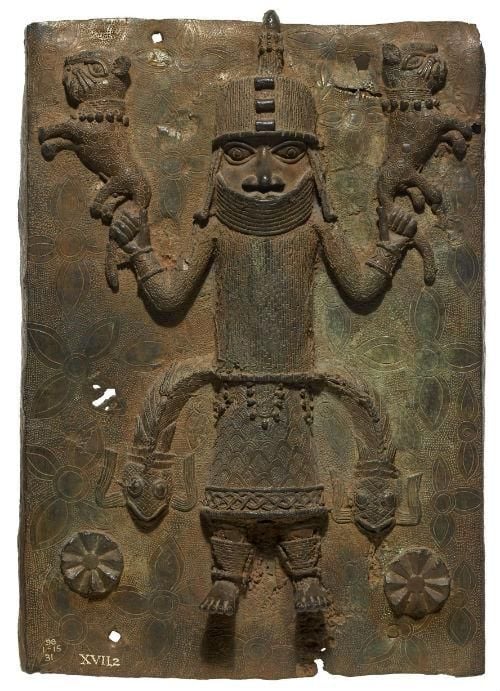
In February 1897, a British Punitive Expedition attacked Benin City — capital of the Benin Empire in present-day Nigeria — in retaliation for a prior military defeat. The expedition sacked the city, burned the royal palace, and removed approximately 3,000–5,000 objects: bronze plaques, ivory carvings, brass heads, and wooden figures that constitute one of the most significant collections of pre-modern African art in existence. These objects — now known as the Benin Bronzes — were distributed to British museums, sold to European private collectors, and exhibited as curiosities.
When European scholars encountered the Benin Bronzes, the Hamitic Hypothesis required a response: objects of this technical and artistic quality could not, by the hypothesis’s logic, have been made by Black Africans. The response was not to revise the hypothesis. The response was to attribute the bronzes to Portuguese influence, to hypothetical Egyptian ancestors, to any external origin that would preserve the hypothesis’s conclusion. The attribution was wrong. The Benin bronze-casting tradition dates to at least the twelfth century CE — centuries before Portuguese contact in 1485. The bronzes were made by the Edo people of Benin, whose ancestors had been casting in bronze for generations. The evidence was available. The hypothesis required that it not be seen.
The Benin Bronzes remain, in their majority, in European institutions — primarily the British Museum, the Ethnologisches Museum in Berlin, and the Weltmuseum in Vienna. The British Museum has approximately 900 objects. The Nigerian government and the Oba of Benin have requested their return for decades. As of 2024, partial repatriations have begun — Germany has returned several hundred objects, and the British Museum’s board has opened discussions — but the majority remain in European institutions. The looting of 1897 and the continued retention of its proceeds are both direct products of the colonial doctrine the Hamitic Hypothesis served.
V. The Demolition
The Hamitic Hypothesis was demolished by the work of African and African American scholars whose names should be as well known as the scholars who built the hypothesis — and are not.
Cheikh Anta Diop (1923–1986), the Senegalese physicist and historian whose 1954 doctoral dissertation Nations nègres et culture (Black Nations and Culture) — initially rejected by the University of Paris and later accepted — marshaled the linguistic, anthropological, physical, and cultural evidence for the African identity of ancient Egypt and the civilizational continuity of sub-Saharan African history. Diop’s analysis of the relationship between ancient Egyptian and sub-Saharan African languages — demonstrating deep structural connections that a Hamitic “Caucasian” origin could not explain — was decisive. His work was published in English as The African Origin of Civilization: Myth or Reality (1974). He is the central figure in the demolition of the Hamitic Hypothesis and one of the most significant scholars of the twentieth century. His name is unknown to most American educated adults.
Chancellor Williams (1905–1992), the Howard University professor whose The Destruction of Black Civilization (1971) documented, across 4,500 years of African history, the systematic pattern of external attack on African civilizational achievement — of which the Hamitic Hypothesis was the scholarly instrument.
John Henrik Clarke (1915–1998), the Pan-African historian and professor at Hunter College whose documentary and editorial work — particularly his editorship of Journal of African Civilizations — made the corrected historical record available to a broad audience.
Ivan Van Sertima (1935–2009), the Guyanese-American scholar whose They Came Before Columbus (1976) documented pre-Columbian African contact with the Americas, and whose edited volume Egypt Revisited (1982) assembled the scientific evidence for ancient Egypt’s African identity.
Molefi Kete Asante (b. 1942), the Temple University professor who developed Afrocentricity as a scholarly framework — insisting that African history be understood from an African rather than a European center, and who has trained generations of scholars in the corrected record.
The 1974 Symposium on the Peopling of Ancient Egypt, convened by UNESCO in Cairo, brought together scholars from across the world to examine the evidence. The symposium’s proceedings documented substantial scholarly consensus that the ancient Egyptian population was African — a consensus that the Hamitic Hypothesis had spent a century obscuring.
VI. The Residue
The Hamitic Hypothesis was formally demolished as a scientific doctrine by the 1960s. It does not appear in contemporary peer-reviewed anthropology or archaeology. It has been replaced by a corrected record that confirms the African authorship of Egyptian civilization, the African origin of Great Zimbabwe, the African production of the Benin Bronzes, and the civilizational sophistication of the West African empires.
The residue remains. It remains in the American school curriculum, which still begins the story of civilization in Greece and Rome. It remains in the popular imagination, which still treats African pre-colonial history as an absence rather than a presence. It remains in the museums of Europe, which still hold the physical evidence of African civilizational achievement behind glass in buildings the objects were never meant to enter. It remains in the instinctive surprise that American readers feel when they learn that the oldest university in the world is in Africa — a surprise that is itself the measure of how thoroughly the hypothesis succeeded.
The Two Americas archive exists, in part, to close the gap between what scholarship has established and what the broader public has been taught. That gap is not an accident. It was created by named scholars, in named institutions, with named publications, over a span of roughly a century. Those names are in this entry. The corrected record is in this archive.
Learn More…The_Hamitic_Hypothesis